

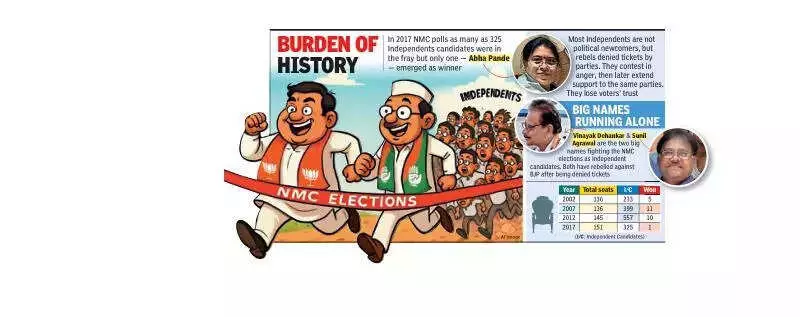
As Nagpur prepares for its Municipal Corporation (NMC) elections, the ballot is set to be crowded with a significant number of Independent candidates. However, a deep dive into the city's electoral history reveals a stark reality: these unaffiliated aspirants often end up merely adding to the numbers rather than securing victory.
The Numbers Tell a Story of Decline
Out of the 993 candidates contesting for 151 seats in the Nagpur Municipal Corporation, a substantial 227 are Independents. Their presence, however, is fragmented and uneven. While six prabhags (electoral zones) have more than ten Independent candidates each, three have just one, and a striking 47 wards have none at all.
This uneven spread is not accidental. Political analysts point to a clear historical trend: as the electoral geography expands, the influence of Independents shrinks. The constant redrawing of electoral boundaries has played a crucial role. In 2002, each prabhag had two wards. This changed to four wards in 2007, was reduced to three in 2012, and expanded back to four in 2017. Campaigning across these larger areas demands resources—workers, funds, communication networks, and booth-level strength—that are typically the forte of organized political parties.

Voter Loyalty and the Perception Problem
The challenge for Independents in Nagpur is not just logistical but deeply behavioural. The city's electorate has shown a strong preference for candidates backed by recognized political parties. A city-based political analyst notes, "An Independent must be exceptionally popular, have a clean image, and a strong public profile. Here, voters rarely choose Independents—even in assembly elections—because of deep loyalty to established parties."
Compounding this is a critical perception issue. Most Independent candidates are not political novices but party rebels who were denied tickets. They often contest in anger, only to later extend support or strike alliances with the very parties they opposed. Over time, voters have come to view Independents as lacking staying power and the ability to deliver on promises.
The electoral results from the past two decades starkly mirror this belief:
- 2002: 233 Independents contested for 136 seats; only 5 won.
- 2007: 399 contested; 11 won.
- 2012: 557 fought for 145 seats; 10 entered the NMC House.
- 2017: 325 were in the fray; only one—Abha Pande—managed to win.
The Rebel Factor and a Glimmer of Hope
Despite the historical odds, writing off Independents completely may be premature. Several rebels from major parties like the Congress and BJP remain in the race. While they may not ultimately secure seats, they possess the potential to split loyal vote banks, disrupt carefully calculated social coalitions, and tilt outcomes in closely fought prabhags. Parties privately acknowledge that managing these rebels is often harder than defeating direct rivals.
Furthermore, widespread public anger over civic issues like potholes, erratic water supply, sanitation lapses, and general civic neglect could open a window of opportunity for a handful of Independents with deep grassroots connections. If they do manage to win, however, they enter a House dominated by party blocs, where influence is dictated by numbers, not just passion or intent.
As the campaign intensifies with door-to-door canvassing and grand promises, the electoral field in Nagpur is undoubtedly noisy. Yet, beneath the clamour lies an unmistakable and persistent pattern: Independents remain the most visible and simultaneously the most vulnerable players in the city's civic politics. Whether the 2022 election breaks this trend or once again relegates Independents to a mere footnote will be revealed on counting day. For now, history continues to cast its vote against them.






