

AMC Internal Probe Uncovers Systemic Heritage Violations in Ahmedabad
An internal investigation by the Ahmedabad Municipal Corporation (AMC) has uncovered a troubling pattern where civic officials allegedly misused a regulatory tool meant for minor regularizations to legitimize illegal alterations in the old city's UNESCO-inscribed heritage homes. The probe, which has been ongoing for six months, reveals that impact fees were collected to bypass mandatory conservation safeguards, exposing what officials describe as a "systemic procedural breach" rather than isolated lapses.
Details of the Heritage Violations
The investigation found that at least five listed heritage properties were regularized after impact fees were collected without securing prior approvals from the Heritage Department and the Heritage Conservation Committee, as required under heritage regulations. Certificates issued by the estate TDO department in the Central Zone effectively allowed unauthorized additions and even changes in land use, directly contravening conservation laws designed to protect Ahmedabad's historic fabric.
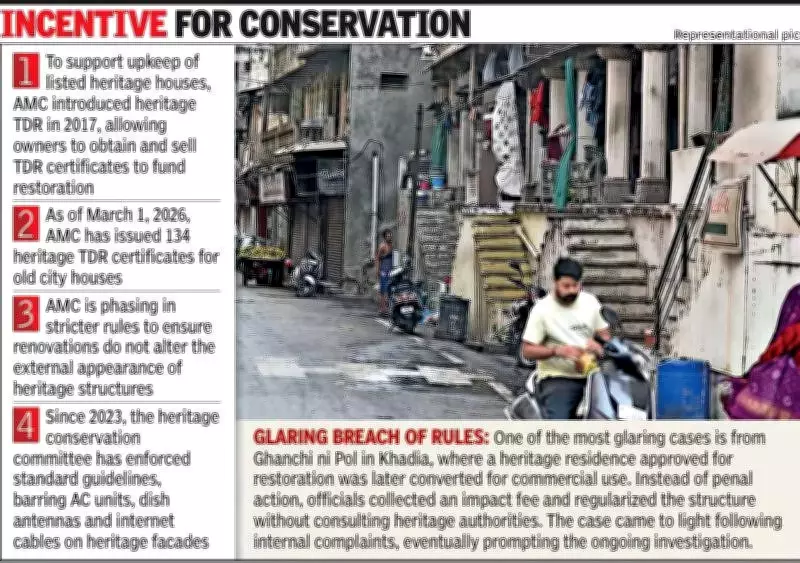
One of the most glaring cases involves a heritage residence in Ghanchi Ni Pol, Khadia, which was originally approved for restoration but was later converted for commercial use. Instead of initiating penal action, officials collected an impact fee and regularized the structure without consulting heritage authorities, highlighting a significant breakdown in compliance.

Background and Context of the Controversy
This controversy is particularly sensitive given Ahmedabad's status as India's first UNESCO World Heritage City, awarded on July 8, 2017. To incentivize preservation, the state introduced Transferable Development Rights (TDR) for owners of listed heritage properties undertaking approved restoration. Over the past nine years, AMC has facilitated the restoration of approximately 134 heritage homes and issued TDR certificates, with the strict condition that no structural changes are made without prior clearance.
However, the probe has revealed that, in stark contrast to these safeguards, impact fees were used to regularize illegal constructions in several heritage properties, undermining both the spirit of conservation policy and the regulatory framework. The Heritage Department has formally flagged that impact fees in such cases were collected "illegally without following due process," indicating a serious lapse in oversight.
Wider Implications and Ongoing Investigation
The inquiry, ordered six months ago and led by the deputy municipal commissioner of the Central Zone, is nearing completion and is expected to be submitted to the municipal commissioner shortly. Officials familiar with the probe indicate that the findings point to repeated circumvention of heritage norms across multiple properties in the walled city, prompting a wider audit of similar cases.
Scrutiny has also widened to the role of retired officials engaged in the regularisation process. According to sources, such officers are often tasked with clearing smaller violations, while assistant and deputy TDOs handle larger cases. Investigators are now examining whether this arrangement contributed to irregular approvals, raising questions about accountability and procedural integrity.
Potential Legal Complications
Further complicating the matter, questions are being raised about possible violations of the impact-fee cut-off date of September 30, 2022. Officials suspect that some unauthorized constructions may have been regularized even after this deadline by accepting fees, a move that could jeopardize the legal standing of such approvals and lead to additional legal challenges.
The case initially came to light following internal complaints, which eventually prompted the ongoing investigation. As the probe concludes, it underscores the critical need for stricter enforcement of heritage conservation laws to preserve Ahmedabad's unique historical legacy and maintain its UNESCO World Heritage City status.






