

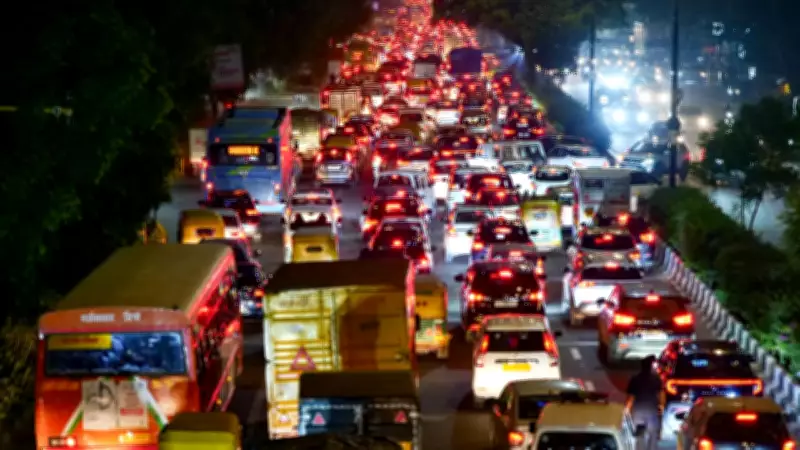
BJP Corporator Proposes Congestion Tax for Mumbai's Business Districts
BJP corporator Makarand Narwekar has formally urged the Brihanmumbai Municipal Corporation (BMC) to develop and implement a comprehensive policy for levying a congestion tax in central business districts, particularly in south Mumbai. The primary objective of this initiative is to utilize the revenue generated from this tax to significantly improve the city's air quality and alleviate chronic traffic congestion.
Targeting Single-Occupant Private Vehicles
Narwekar's proposal specifically targets private vehicles with single occupants entering designated high-traffic zones. He argues that such a measure would discourage unnecessary vehicle usage and incentivize a shift towards public transportation. This call to action comes amid growing concerns over Mumbai's deteriorating air quality and increasingly gridlocked roads.
Historical Context and Stalled Proposals
This is not the first time such a measure has been discussed for the metropolitan region. Last year, the Mumbai Metropolitan Region Development Authority (MMRDA) deliberated on a proposal to impose a congestion fee on vehicles spending 50 minutes or less in the Bandra-Kurla Complex (BKC) to ease traffic in that specific area. However, that proposal has seen no further progress, highlighting the challenges in implementing such systemic changes.

Expert Endorsement and Global Precedents
Transportation experts have largely endorsed the concept of congestion pricing for Mumbai, provided it is executed holistically. Amit Bhatt, India Managing Director of The International Council on Clean Transportation, emphasized that cities worldwide are actively managing vehicle numbers on their roads.
"Even car-producing nations like China have implemented restrictions on vehicle registrations," Bhatt noted. "Managing vehicle numbers can be achieved either by restricting registrations or by imposing a congestion tax. Major global cities like London, New York, and Singapore already employ congestion taxes effectively."
Bhatt further cautioned that if vehicle numbers increase beyond a sustainable threshold, the city risks complete gridlock. He stressed that Mumbai's policy must account for its heterogeneous traffic mix and that all generated revenue must be reinvested into sustainable transport infrastructure.
The Imperative for Integrated Public Transport
A V Shenoy of the Mumbai Mobility Forum strongly endorsed the congestion pricing idea, linking it directly to public transport capacity. "With 400 to 500 new vehicles registered in Mumbai every day, no amount of flyover construction can accommodate this growth," Shenoy stated. "Congestion pricing and the provision of robust, reliable public transport must be developed in tandem. We must ensure good alternatives for those who cannot or choose not to use private cars."
Proposed Implementation Mechanism
Corporator Narwekar has outlined a potential implementation framework for the proposed tax:
- Demarcate high-traffic zones using the city's existing CCTV network.
- Install Automatic Number Plate Recognition (ANPR) cameras at all entry points to these zones.
- Identify the most traffic-prone areas across the city for priority action.
- Enable automatic toll deduction via FASTag at designated checkpoints, ensuring seamless collection.
He suggested that the policy could be launched on a pilot basis in severely congested central business districts like south Mumbai. The dual aim is to disincentivize non-essential car travel while simultaneously generating a dedicated revenue stream for urban mobility and environmental projects.
The proposal now rests with the BMC, requiring detailed deliberation on its feasibility, potential impact, and alignment with the city's broader transportation and environmental goals.






