

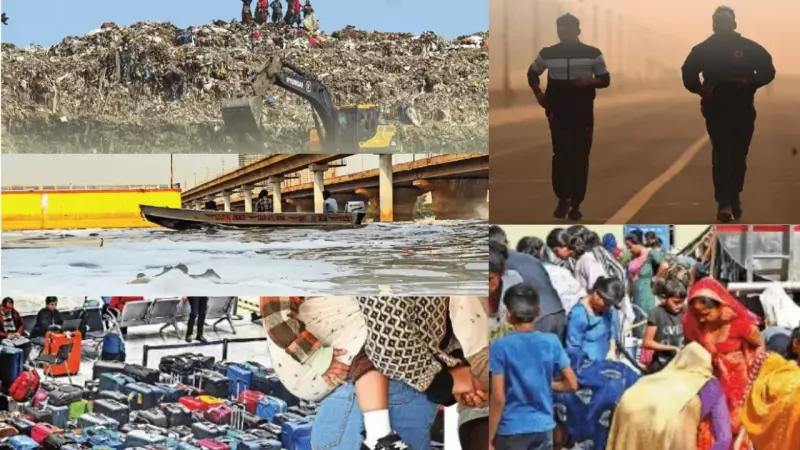
The year 2025 presented a complex picture for India's capital, Delhi. While the city grappled with persistently severe air pollution, unprecedented airport chaos, and a surge in sophisticated cybercrime, there were also measured gains in healthcare access and some civic initiatives. The narrative was one of persistent challenges interspersed with pockets of progress.
The Persistent Haze: Air Quality's Mixed Signals
Delhi's winter air remained a critical concern, though data indicated a slight shift. The average Air Quality Index (AQI) for November stood at 357, a marginal improvement from 375 in November 2024, yet firmly in the 'very poor' category. A key factor was a noted reduction in stubble-burning incidents in neighbouring states, which helped keep peak pollution levels in early winter lower than the previous year, according to a Centre for Science and Environment (CSE) analysis.
However, the overall crisis deepened. October 2025 was the second most polluted October in five years, with an average AQI of 223. The city endured eight 'severe' air quality days this winter, with AQI crossing 400. December 2025 turned out to be the most polluted December since 2018, averaging an AQI of 350. The highest single-day AQI peaked at a alarming 461 on December 14, the second-highest ever recorded for a December day.

Most tellingly, Delhi once again failed to record a single 'good' air quality day (AQI below 51) in 2025. The last such day was in 2023. From January 1 to December 29, the city recorded 163 days with AQI above 200, higher than 156 days in 2024 and 157 in 2023. CSE experts warned that as farm fire contributions reduced, local pollution sources were becoming the dominant drivers.
Travel Turmoil: A Year of Airport Disruptions
For air travellers, 2025 was a year of severe inconvenience. Flight operations at Indira Gandhi International Airport (IGIA) faced repeated disruptions from multiple quarters.
The troubles began in summer with the closure of runway 28/10 for upgrades in April, compounded by unusual wind patterns. In May, over 200 flights were cancelled following Operation Sindoor by the Indian armed forces, which led to temporary closures of several domestic airports. International airspace closures over Iran and Iraq, and even a power outage at London's Heathrow, added to the cascading delays.
The situation reached a peak in December. The first half saw the IndiGo crisis lead to over 1,100 flight cancellations. The second half was marred by dense fog, causing massive delays and cancellations daily. On December 15 alone, over 800 flights were delayed, more than 200 cancelled, and five diverted. The only silver lining was the opening of the revamped Terminal 2, offering a glimpse of future capacity.
Civic Strain: Waste, Water, and Financial Stress
On the civic front, Delhi's Solid Waste Management bylaws saw uneven implementation seven years after notification. However, resident-led initiatives showed promise. Colonies like Navjeevan Vihar and parts of Vasant Kunj, through partnerships with the Municipal Corporation of Delhi (MCD), achieved 100% waste segregation and decentralized composting. By year-end, Delhi had 676 zero-waste colonies, though this remains a small fraction of the city.
The MCD itself faced severe financial strain, with liabilities ballooning to Rs 15,791.8 crore. Despite this, the commissioner proposed no new taxes in the 2026-27 budget. The city's three giant landfills—Ghazipur, Bhalswa, and Okhla—continued to grow, with only 156.4 million tonnes of legacy waste processed against 136.8 million tonnes remaining. Fresh dumping of 3,000-3,500 tonnes daily persisted.
Water supply saw temporary relief due to a milder summer and better coordination with Haryana and Uttar Pradesh. However, frequent ammonia spikes in the Yamuna disrupted supply in areas like Vasant Kunj, Defence Colony, and Punjabi Bagh, exposing the fragility of the system.

The Digital Battlefield: Cybercrime Surge and Police Response
Cybercrime emerged as a major threat, growing in both scale and sophistication. To improve redressal, Delhi Police lowered the threshold for registering cyber e-FIRs from losses above Rs 10 lakh to Rs 1 lakh or more. Integrated help desks were set up across all police stations to ease jurisdiction issues.
Despite these steps, fraudsters refined their tactics. While 'digital arrest' scams grabbed headlines, investment frauds luring victims into fake share trading and IPO schemes were widespread. By June, 184 major cybercrime cases had resulted in losses of Rs 70.6 crore. Estimates suggested total losses for 2025 could cross a staggering Rs 1,200 crore.
Healthcare: Steps Forward Amid Persistent Gaps
The health sector posted measurable gains. The rollout of 238 Ayushman Arogya Mandirs provided free primary care and diagnostics, reducing pressure on hospitals. The operationalisation of Ayushman Bharat-PMJAY extended Rs 5-lakh cashless health cover to all Delhi residents aged 70 and above.
Government hospitals also upgraded diagnostic capacity and rolled out online OPD registration. Yet, severe staff shortages, medicine stock-outs, and violence against doctors continued to strain the system. Incidents of assault, like the one on a resident doctor at Dr Baba Saheb Ambedkar Hospital in June, persisted, prompting measures like panic button systems for women staff.
Government Promises: Hits, Misses, and Stalled Plans
The BJP-led Delhi government delivered on some budget promises, including the Ayushman schemes, approving Yamuna cleaning projects worth Rs 3,140 crore, and initiating processes to operationalise 11 stalled hospital projects via PPP.
However, several announcements remained incomplete. The Mahila Samriddhi Yojana (Rs 2,500 monthly for poor women) saw cabinet approval but no further progress. Plans for free laptops for students, 100 Atal Canteens, and the installation of 50,000 CCTV cameras were delayed or only partially implemented. Headline promises like free LPG cylinders on festivals and an International Film Festival did not materialise.
As the year closed, Delhi's story remained one of a megacity battling multifaceted crises while striving for incremental improvements in the daily lives of its residents.





