

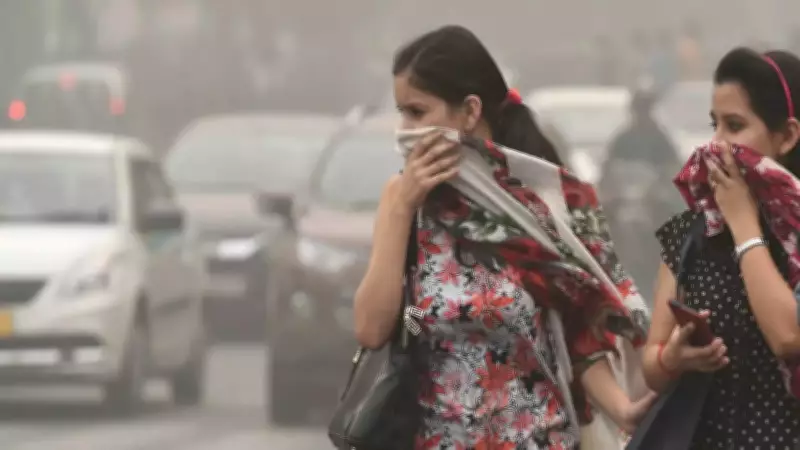
Delhi Chief Minister Rekha Gupta Launches Major Air Quality Monitoring Expansion
Delhi Chief Minister Rekha Gupta on Monday inaugurated six new Continuous Ambient Air Quality Monitoring System (CAAQMS) stations and flagged off 100 'Vayu Rakshak' vehicles, marking a significant step in the capital's fight against pollution. Speaking at an event held at the Delhi Secretariat, Gupta emphasized that pollution control demands sustained, year-round action rather than seasonal measures.
Comprehensive Monitoring Network for Accurate Data
Gupta outlined the government's ambitious plan to ensure comprehensive citywide monitoring. "Our aim is to ensure that for every 25 square kilometer area in Delhi, there is at least one air quality monitoring station," she declared. This initiative aims to provide complete and accurate data on pollution levels and their sources across residential areas, industrial zones, traffic corridors, and green belts.
The six new monitoring stations, established by the Commission for Air Quality Management (CAQM), are strategically located at:

- Jawaharlal Nehru University
- Indira Gandhi National Open University
- Netaji Subhas University of Technology West Campus in Dwarka
- CWD Akshardham
- Sarvodaya Bal Vidyalaya in Delhi Cantt
- Dr Syama Prasad Mookerjee Swimming Pool Complex at Talkatora Garden
With these additions, Delhi now operates 46 air quality monitoring stations. Gupta announced plans to install 14 additional stations in the coming phase to achieve full coverage. "Pollution is not a seasonal problem. It requires 365-day caretaking, continuous monitoring, and sustained action," she asserted, noting that air safety officers will be deployed for year-round supervision and enforcement.
Strengthening Enforcement with Vayu Rakshak Vehicles
The newly flagged off 'Vayu Rakshak' vehicles represent a crucial enforcement mechanism. These 100 vehicles will conduct stricter monitoring and enforcement of pollution control norms across Delhi, targeting industrial, vehicular, hotel, and institutional pollution sources.
Delhi Environment Minister Manjinder Singh Sirsa, who also addressed the event, elaborated on this initiative. "To ensure strict monitoring, 100 'Vayu Rakshak' vehicles will be deployed across Delhi," Sirsa stated, adding that 100 permanent surveyors will be appointed for year-round physical inspections. He highlighted improved coordination among the Delhi Pollution Control Committee (DPCC), CAQM, and the central government, leading to systematic monitoring and data-based policy planning.
Multi-Sectoral Approach to Pollution Control
Gupta detailed the government's comprehensive strategy to strengthen pollution control across multiple sectors, including transport, roads, waste management, and green cover. "Clean air is a right, and we are committed to delivering it with seriousness and long-term planning," she affirmed.
In transportation, Delhi currently operates the highest number of electric buses in the country, with 4,200 vehicles already on the roads. "By 2028, this number will increase to 14,000, which will significantly reduce vehicular emissions," Gupta projected. The government is also upgrading pollution checking infrastructure with automated vehicle testing stations and preparing a new electric vehicle policy for private vehicles.
Regarding green initiatives, Gupta described the notification of large parts of the Delhi Ridge as forest land as a historic step. She emphasized that protecting green spaces is essential for improving Delhi's environmental health and ensuring long-term sustainability.
Criticism of Previous Approaches and Waste Management Progress
Gupta criticized previous governments for treating pollution as a short-term issue. Referring to measures like smoke towers and odd-even schemes, she dismissed them as "cosmetic solutions" that failed to address pollution at its root.

Sirsa provided updates on waste management progress, noting that approximately 85% of Delhi's daily waste generation—around 12,500 metric tonnes—is now processed for energy production. He addressed the challenge of legacy waste, revealing that the present government inherited three garbage dumps spread over 202 acres and about 60 meters high. "In just one year, garbage has been cleared from around 45 acres, and the height of the remaining dumps is being reduced," Sirsa reported.
Sirsa also alleged that previous governments failed to address core pollution causes like road dust, vehicle emissions, and garbage mountains, instead resorting to blame-shifting. The current administration's approach focuses on systematic monitoring, data-driven policies, and multi-sectoral interventions to tackle pollution at its source.





