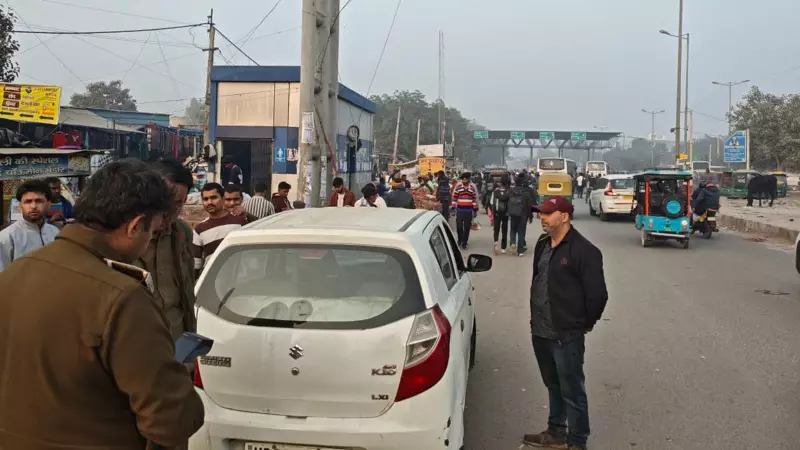
The first day of the latest traffic restrictions in Delhi, aimed at curbing severe air pollution, was marked by confusion and inconsistent enforcement. A ground report from key border points on Thursday, December 19, 2025, revealed a surprising scene: personnel from the Municipal Corporation of Delhi (MCD) and the National Highways Authority of India (NHAI) collecting tolls were far more numerous than Delhi Police officials tasked with stopping polluting vehicles.
Spotty Police Presence at Entry Points
Visits to several critical entry points into the capital—including the Kapashera border, Sarhol on the Delhi-Jaipur Expressway, M G Road, and Surajkund Road connecting Faridabad to Delhi—painted a clear picture. While toll booths were fully operational, a consistent police presence to enforce the Graded Response Action Plan (GRAP) curbs was found only at the Kapashera and M G Road borders.
At the Sarhol and Badarpur toll plazas, as well as on Surajkund Road leading to Tughlakabad via the Asola Bhatti sanctuary, there were no police personnel to check vehicles for compliance with pollution norms. This gap allowed a stream of commercial vehicles to pass through unchecked, with no verification of whether they were running on CNG or met the BS-VI emission standard.

Confusion Among Officials on the Ground
Even where police were deployed, there was evident uncertainty about the specifics of the restrictions. At the bustling Kapashera border, a policeman was overheard asking his colleague for clarification: “Are BS-IV vehicles registered in Delhi also banned?” The heavy traffic flow also meant that not every vehicle could be stopped for inspection.
Despite the challenges, enforcement did occur. By around 4:30 PM, a zonal traffic sub-inspector at Kapashera reported that at least 10 non-compliant cars had been turned back, and more than 30 others had been issued challans (fines). “We are checking the vehicles we suspect, even the CNG and BS-VI ones, for valid Pollution Under Control Certificates (PUCCs),” the officer stated.
On-the-Spot Checks and Minor Snarls
During the inspection, the process was observed firsthand. A Maruti Alto was pulled over on suspicion of being an older, more polluting model. Its registration details were entered into a handheld challan machine. While the vehicle's emissions standard was found to be compliant, its PUCC had expired. The driver was let off with a strict warning to obtain a valid certificate immediately.
On M G Road, the act of three Delhi Police officials stopping and checking vehicles created a minor traffic jam at the border U-turn, highlighting the logistical impact of such checks during peak hours. However, this was a sign of active enforcement, which was conspicuously absent at other major corridors.
The day's observations underscore a significant implementation gap in Delhi's pollution control strategy. The success of such traffic curbs hinges on uniform and knowledgeable enforcement across all entry points. With the first day revealing a shortage of police manpower and clarity, the effectiveness of these measures in meaningfully reducing vehicular pollution remains in question.