

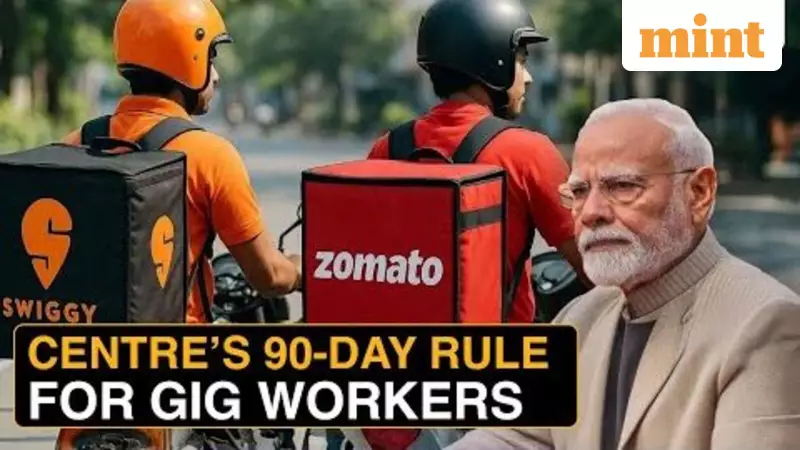
In a landmark move aimed at India's vast informal workforce, the Union Labour Ministry has unveiled draft rules that could extend social security benefits to millions of gig and platform workers. The proposed framework, set to take effect from April 1, 2026, introduces specific eligibility criteria centered on the duration of work.
Decoding the Eligibility: The 90-Day Threshold
The core of the new proposal lies in a minimum work requirement. To qualify for social security schemes notified by the government, a gig or platform worker must have engaged in work for a minimum number of days in a financial year. The draft stipulates that workers associated with a single aggregator or platform need to complete 90 days of work. For those who work with multiple aggregators, the threshold is set slightly higher at 120 days.
Crucially, the definition of a 'work day' is highly inclusive. The ministry's draft clarifies that even earning a single rupee in a day counts as a day of work. This provision is designed to cover a wide spectrum of engagement, from part-time to full-time gigs. Upon meeting this eligibility, workers will be provided with a digital identity card to facilitate their inclusion in the social security net.

A Historic Step Forward or a Barrier to Inclusion?
The release of these draft rules under the four new Labour Codes marks a significant policy shift. For years, activists and worker unions have advocated for formal recognition and protection for the country's growing gig economy workforce. This move by the Modi government is being viewed as a direct response to those calls, potentially offering a safety net to a sector characterized by job instability and lack of benefits.
However, the proposal has also sparked debate. While many hail it as a historic step, others question whether the 90-day minimum could become an exclusionary barrier. Critics argue that workers with highly irregular or sporadic engagement—common in the gig economy—might find it challenging to meet the cumulative day requirement, thus missing out on the very benefits the scheme intends to provide.
Next Steps and Public Consultation
The draft rules are not yet final. The Labour Ministry has opened a consultation window of 30 to 45 days, inviting feedback from stakeholders, including worker associations, platform companies, and the public. This period, following the draft's release on January 2, 2026, will be critical in shaping the final policy.
The outcome of this consultation and the final implementation from April 2026 will be closely watched. It has the potential to redefine the social contract for millions of Indians who drive cabs, deliver food, and perform countless other tasks through digital platforms, setting a precedent for the future of work in the digital age.






