

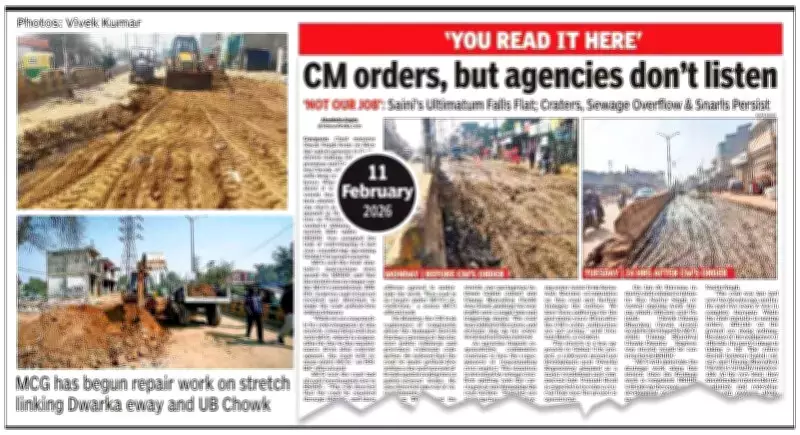
Gurgaon Road Repair Work Commences Following Chief Minister's Directive
Gurgaon: Two days after Haryana Chief Minister Nayab Singh Saini issued a strict 24-hour deadline to fix a severely deteriorated 4-kilometer stretch between Umang Bhardwaj Chowk and Dwarka Expressway, the Municipal Corporation of Gurugram (MCG) finally initiated repair work on Wednesday. This development underscores the persistent gap between high-level political directives and their practical execution on the ground.
Immediate Patchwork Repairs Underway
MCG officials stated that the immediate plan involves clearing the road of accumulated slush and sewage water, followed by filling the numerous deep potholes using granular sub-base (GSB) material to restore basic motorability. "We are first going to clear the road and then fill potholes using granular sub-base. Both lanes of the Dwarka Expressway stretch will be rectified," confirmed an MCG official. However, the official clarified that comprehensive redevelopment of the road is slated to be carried out by the Haryana State Industrial and Infrastructure Development Corporation (HSIIDC) within a timeframe of three to six months.
Political Directive and On-Ground Reality
On Monday, Chief Minister Saini took note of numerous complaints during a district grievance redressal meeting and directed concerned agencies to repair the hazardous road within a single day, issuing a stern warning against any negligence in public-interest works. Despite this clear order, a visit by The Times of India to the site on Tuesday revealed the road remained virtually impassable. One carriageway was completely shut, forcing two-way traffic to squeeze into a single lane, while sewage water pooled on the surface and deep craters posed significant dangers to commuters.

Agency Blame Game Over Jurisdiction
When questioned about the road's deplorable condition and the delay in acting on the CM's orders, a blame game ensued between the two responsible agencies. MCG officials initially contended that the Chief Minister's directions were intended for HSIIDC, asserting that the road no longer fell under MCG's jurisdiction. HSIIDC countered this claim, stating that while it holds responsibility for long-term redevelopment, day-to-day maintenance and ownership currently rest with MCG. "We did not receive any direction to make the road pothole-free within 24 hours," an HSIIDC official remarked, highlighting the communication and responsibility disconnect.
Resident Frustration and Calls for Permanent Solution
Local residents expressed deep frustration over the situation. "Why should the CM have to step in for something as basic as road repairs? This is clearly the responsibility of civic authorities. Unfortunately, it often appears that action is taken only after directions come from the top political leadership," said Udaybir Yadav, former RWA President of Sector 10A. He criticized the temporary patchwork approach, noting, "Filling potholes with GSB without proper bituminous patchwork only worsens dust pollution and offers no lasting solution. What this road requires is complete redevelopment, and that too without any further delay."
Historical Context and Strategic Importance
The road in question serves as a crucial approach to the upcoming 1,000-acre Global City project, amplifying its strategic importance for Gurgaon's infrastructure. Residents report that the stretch has not been relaid in over two decades and has remained in a state of disrepair for the past five years, with civic neglect persisting despite repeated complaints. This issue was previously highlighted during a review meeting on January 20, where Haryana's Industry and Commerce Minister Rao Narbir Singh assessed key development works. Officials clarified at that meeting that the Pataudi Chowk–Umang Bhardwaj Chowk section would be developed by MCG, while the Umang Bhardwaj Chowk–Dwarka Expressway stretch falls under HSIIDC's purview for construction.
The ongoing repair efforts, while a response to political pressure, bring to the forefront systemic issues of inter-agency coordination, accountability, and the urgent need for permanent infrastructure solutions in rapidly developing urban areas like Gurgaon.






