Gurgaon's Traffic Chaos Forces Foreign Bureaucrats to Walk to Meeting
In an embarrassing incident that put Gurgaon's notorious traffic problems under an uncomfortable spotlight, a bus transporting senior bureaucrats from developing countries became ensnared in a massive gridlock outside the mini secretariat on Tuesday. The delegation, comprising chief secretaries, directors, and secretary-level officers from Sri Lanka, Tanzania, Mali, Niger, and Burkina Faso, was compelled to disembark and proceed on foot to the complex.
Chronic Congestion Disrupts Governance Training
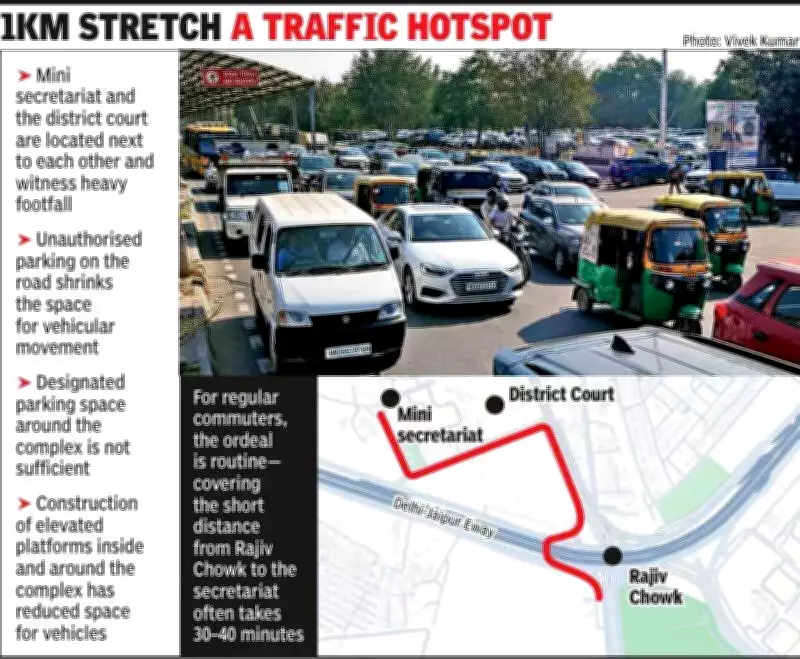
The visitors were in the city to participate in a training program organized by the National Centre for Good Governance, aimed at learning about effective governance and public service delivery. Ironically, their initial lesson turned out to be a firsthand experience of one of Gurgaon's most persistent issues: severe traffic congestion. For regular commuters, this gridlock is a daily ordeal, but for the international delegates, it served as an unexpected and stark illustration of urban management challenges.
Residents report that the short stretch from Rajiv Chowk to the mini secretariat frequently takes 30 to 40 minutes during peak office hours, with vehicles crawling in long queues. The approach road is a narrow lane that remains perpetually choked, despite leading to one of the district's most critical administrative hubs. The mini secretariat houses key offices, including those of the deputy commissioner and DCP (west), and is adjacent to the district court, which attracts thousands of visitors daily.

Safety Risks and Infrastructure Criticisms
The combination of heavy footfall and inadequate parking space transforms access to the complex into a daily struggle. Pravin Sharma, a resident of Sector 15, remarked, "Getting in and out of the complex area is more difficult than getting work done inside the government office." He also criticized poorly planned construction around the premises, noting that "strange platforms" have appeared without clear purpose, blocking potential parking areas and contributing to year-round dirtiness.
Others have raised concerns about safety risks. Sumit Kumar, a resident of Sector 40, warned, "If there is a fire, a tender won't be able to reach the building so easily." He added that even senior officials could face difficulties evacuating quickly in emergencies, underscoring the broader implications of the congestion beyond mere inconvenience.
Administrative Response and Delegation Briefing
Deputy Commissioner Ajay Kumar acknowledged the issue, stating that the administration will endeavor to find solutions and streamline traffic movement. Regarding the delegation's training, Kumar detailed that the foreign bureaucrats were briefed on various government initiatives, including:
- The family ID card scheme and its delivery mechanisms.
- The Antyodaya Saral portal, which has digitized citizen services.
- Steps to simplify revenue work and reduce corruption through computerization of land records.
- Women empowerment programs such as the 'Lado Lakshmi Yojana'.
- Agricultural measures like 'Mera Pani, Meri Virasat'.
- Social security schemes, health service expansions, skill development, and employment generation for youth.
- Efforts to strengthen urban infrastructure.
Despite the traffic mishap, the officials departed on a positive note, having gained insights into India's governance models. However, the incident serves as a poignant reminder of the urgent need to address Gurgaon's traffic woes to align with the city's aspirations as a hub of good governance and efficient public service delivery.