

Jaipur Development Authority and RITES Craft Future Mobility Blueprint for 2055
In a strategic move to address the needs of a projected population exceeding one crore by 2055, the Jaipur Development Authority (JDA), in partnership with RITES, has unveiled a comprehensive mobility plan (CMP) for Jaipur. This forward-thinking initiative aims to revolutionize urban transportation, ensuring efficient and sustainable connectivity across the city.
Metro Expansion: Seven Alignments Spanning 138 Kilometers
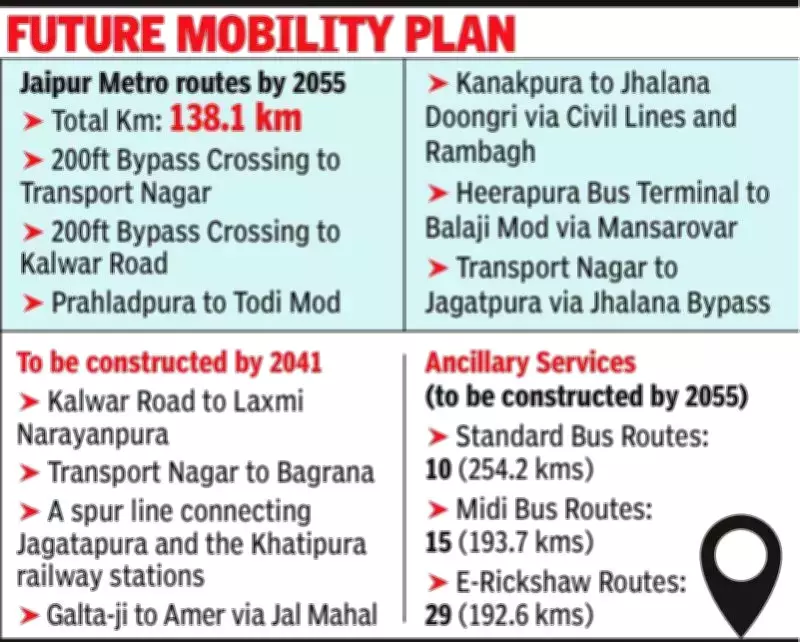
The cornerstone of the plan is the development of seven metro railway alignments, covering a total distance of 138 km. These alignments are designed to form the backbone of Jaipur's future public transport network, with city bus services, cabs, autorickshaws, and e-rickshaws serving as crucial last-mile connectivity providers. An official emphasized that routes for private or state-run JCTSL buses will not run parallel to the metro lines. Instead, they will strategically link metro alignments to each other and to other areas of the city, optimizing overall network efficiency.
Phased Implementation and New Corridors
The mobility plan outlines a phased approach to metro development. In addition to Phase 1, which is set to connect the 200 Feet Bypass Crossing and Transport Nagar within the next two to three years, and the previously announced Phase 2 from Prahladpura in Sitapura to Todi Mod, three new corridors with eight alignments are projected to be operational by 2055. This expansion will significantly enhance metro coverage, catering to the growing urban sprawl and population density.

Transition to E-Buses and Feeder Services
By 2055, all city buses are slated to be electric, available in two variants: standard and midi. As ancillary services to the metro corridors, the plan includes running standard buses on 10 routes and midi buses on 15 routes. Furthermore, 29 routes have been designated for e-rickshaws to complement and act as feeders to the bus and metro services. To ensure smooth traffic flow, 10 routes are proposed to be declared as 'No E-rickshaw Zones,' balancing accessibility with congestion management.
Ensuring Integrated and Sustainable Transport
This comprehensive mobility plan underscores a commitment to integrated and sustainable urban transport. By focusing on metro expansion, electrification of buses, and optimized feeder networks, Jaipur aims to reduce traffic congestion, lower emissions, and improve overall mobility for its residents. The collaboration between JDA and RITES highlights a data-driven approach to urban planning, poised to transform Jaipur into a model city for future-ready transportation systems.






