Kerala's Senior Citizens Helpline Faces Operational Crisis
Significant uncertainty now clouds the future functioning of Kerala's national helpline for senior citizens, operated under the state's social justice department. This crisis emerges directly from the Centre's directive requiring all states to discontinue their state-level offices and convert the service into a centralized zonal project by the March 31 deadline.
Election Timing and Service Disruption Concerns
With crucial assembly elections scheduled in the coming months, state officials express deep apprehension. They fear that dismantling the existing, well-established network could severely disrupt the operations of Elderline (14567), which has evolved into a vital support system for the elderly population across Kerala.
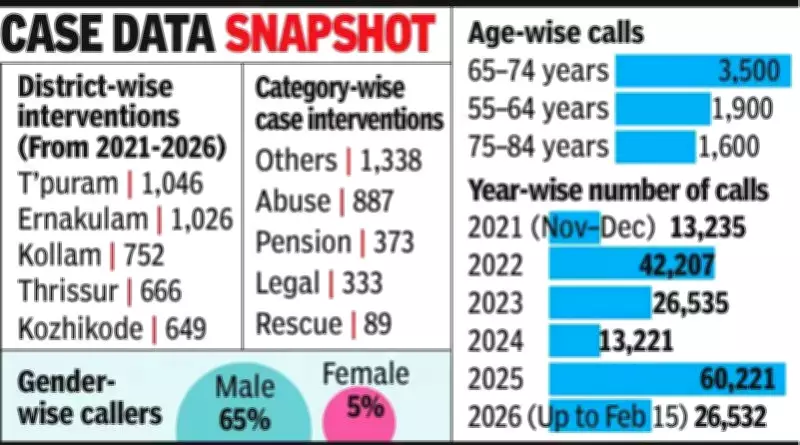
During the current financial year up to February 15, 2026, Elderline Kerala has managed an impressive 81,189 calls, maintaining a consistent average of approximately 258 calls per day. This helpline also serves as the official implementation channel for the Sallapam project.

Critical Functions and Legal Mandate
The Elderline helpline performs multiple essential functions. It acts as the primary contact point for rapid response teams and handles monitoring for all cases registered under the Maintenance and Welfare of Parents and Senior Citizens Act of 2007. This legal framework ensures protection and support for elderly citizens across the state.
Previous Centralization Attempts and Their Impact
Biju Mathew, the state coordinator of HelpAge Kerala, provided crucial context regarding previous centralization efforts. "When the Centre outsourced Elderline operations in several states, numerous call centers secured the contracts," Mathew explained. "However, unlike established elder welfare organizations such as HelpAge or dedicated social justice departments, these call centers frequently failed to conduct necessary follow-ups. This deficiency significantly affected the helpline's overall effectiveness, ultimately prompting the Centre's current decision."
Mathew further emphasized, "Nevertheless, it would be substantially better if the service continues under the supervision of social justice departments with strategic support from certified agencies. In Kerala specifically, the system functioned with remarkable effectiveness under this model in earlier periods."
Statistical Performance and Recent Challenges
Officials revealed comprehensive data showing that from 2021 onward, the helpline successfully handled a total of 181,951 calls, averaging 3,831 calls per month. However, the service faced significant challenges in 2023 when field-level operations were discontinued, project funding was substantially reduced, and services were scaled down dramatically.
After enduring nearly two years of operational constraints, the helpline regained its strength around mid-2025 and has been functioning with renewed efficiency since that recovery period.
User Challenges and Localized Needs
Arun Raj, the state coordinator of Elderline, highlighted specific challenges faced by elderly callers. "Many senior citizens are unfamiliar with navigating complex language options or multiple automated prompts required to access services," Raj stated. "We consistently receive calls seeking state-specific information, including pension details, various welfare schemes, and requests for in-person assistance at local government offices."
This localized knowledge and personalized assistance represent core strengths of the current state-operated system that could be jeopardized by complete centralization.