

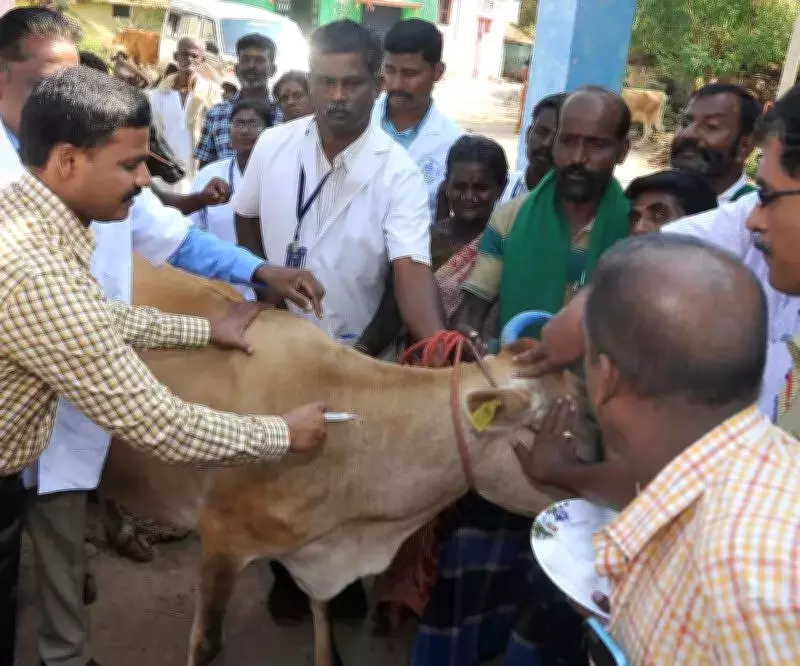
Kota District Uncovers Suspected Fake Animal Vaccination Entries on National Digital Portal
Suspected large-scale fraudulent entries of animal vaccinations under the National Animal Disease Control Programme (NADCP) have emerged on the Union government's National Digital Livestock Mission (NDLM) portal, raising serious concerns about implementation gaps and potential financial misuse linked to tagging and vaccination incentives.
How the National Animal Disease Control Programme Operates
Under this nationwide programme, each animal is assigned a 12-digit unique identification number that is verified through a One-Time Password (OTP)-based mobile application. Owner details and other critical information are then uploaded to the central NDLM portal. Veterinary technicians receive compensation of Rs 5 for tagging an animal and an additional Rs 3.50 for administering each vaccination.
Discrepancies Found in Kota District Records
Scrutiny of NDLM portal entries specifically in Kota district has uncovered records that do not match field claims made by the listed animal owners. In one particularly glaring case, an entry for "Kadirn" of Modak Station in Ramganjmandi showed 50 animals vaccinated against a listed mobile number.

When contacted, Yogesh Meena, who received the call at that number, stated emphatically: "I own only two cows and a calf," adding that none of his animals had been vaccinated and that no person named Kadirn lives at that location. The technician listed for this entry, Kavita Kumari, was shown with a nine-digit mobile number instead of the customary ten digits.
Multiple Cases of Questionable Documentation
In another case from the same area, Abdul Khan was recorded as owning 111 vaccinated cows. He clarified that he previously had 25 cattle but "all sold over a year ago." Multiple similar instances have been documented, fueling allegations that vaccination details were uploaded without proper field verification and that some immunization records may exist only on the digital portal.
People within the veterinary department have also raised significant questions about:
- Login access controls
- Mechanisms to prevent unauthorized data changes
- System monitoring protocols
According to accounts, these concerns "remained ignored" by authorities.
Official Acknowledgment and Departmental Response
A veterinary department official acknowledged discrepancies "in many cases," citing pressure to meet targets and resistance from cattle owners to tagging and vaccination procedures. Sources indicated that weak record-keeping practices and inadequate system oversight may have enabled false reporting.
Dr. Ganesh Narayan Dadich, additional director in the veterinary department in Kota who served as supervising authority at the time, directed inquiries to the incumbent joint director. However, joint director Dr. Neetesh Bhardwaj could not be reached for comment as his phone was switched off.
Background on the National Animal Disease Control Programme
The NADCP was launched in September 2019 by the Union government and is implemented in collaboration with the National Dairy Development Board (NDDB). The ambitious programme aims to:
- Control Foot and Mouth Disease (FMD)
- Control Brucellosis
- Eradicate both diseases by 2030 through 100% vaccination coverage
The comprehensive scheme covers cattle, buffalo, sheep, goats, and pigs for FMD, and bovine female calves aged 4–8 months for Brucellosis. Brucellosis is an infectious bacterial disease primarily transmitted to humans through unpasteurized dairy products or direct contact with infected animals.






