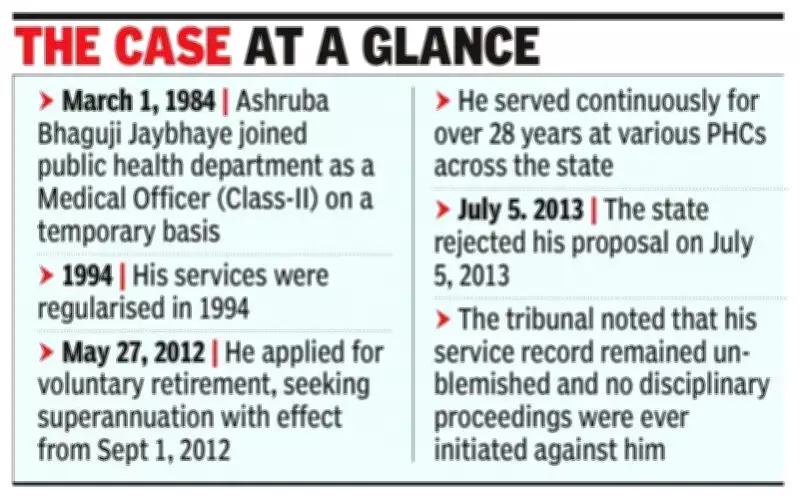
The Maharashtra Administrative Tribunal (MAT) Mumbai bench at Aurangabad has delivered a significant ruling, stating that temporary service rendered before regularisation must be considered as qualifying service for pensionary benefits and voluntary retirement. The decision came in the case of Ashruba Bhaguji Jaybhaye versus the State of Maharashtra.
Case Background
Ashruba Bhaguji Jaybhaye joined the public health department on March 1, 1984, as a Medical Officer (Class-II) on a purely temporary basis at the primary health centre in Raimoha, Beed district. He served continuously for over 28 years at various primary health centres across the state without any break in service. His service record remained unblemished, and no disciplinary proceedings were ever initiated against him.
Regularisation and Voluntary Retirement Application
Jaybhaye's services were regularised in 1994 after he cleared a special examination conducted by the Maharashtra Public Service Commission (MPSC). He later applied for voluntary retirement on May 27, 2012, seeking superannuation with effect from September 1, 2012, under Rule 66 of the Maharashtra Civil Services (Pension) Rules, 1982. However, the state rejected his proposal on July 5, 2013, contending that he had not completed the mandatory 20 years of qualifying service. The authorities counted his service only from the date of regularisation in 1994, excluding the previous 10 years of temporary service.

Tribunal's Ruling
The division bench of the tribunal, headed by Justice VK Jadhav (vice-chairman) and Vinay Kargaonkar (member), held that statutory pension rules prevail over executive government resolutions. The bench noted that continuous temporary service cannot be ignored while calculating qualifying service for pension and voluntary retirement benefits. The applicant, through advocate Renuka Ghule, argued that Rule 30 of the Pension Rules clearly states that qualifying service begins from the date a government servant first takes charge of a post, whether in a substantive, officiating, or temporary capacity.
Automatic Retirement by Operation of Law
The tribunal further held that under Rule 66(2), if a voluntary retirement application is not rejected within the prescribed notice period, retirement takes effect automatically by operation of law. Since the state rejected Jaybhaye's application more than a year after the notice period expired, the tribunal held that he stood voluntarily retired from September 1, 2012.
Order and Implications
Allowing the application, MAT quashed the rejection order, declared Jaybhaye retired with effect from September 1, 2012, and directed the state to calculate his qualifying service from March 1, 1984. It ordered authorities to release all pensionary and retiral dues, including gratuity and group insurance benefits, within three months. Failing this, the state will have to pay 6% annual interest on arrears from September 1, 2012, until actual payment. This ruling sets a precedent for government employees whose temporary service prior to regularisation is often disregarded for pension calculations.