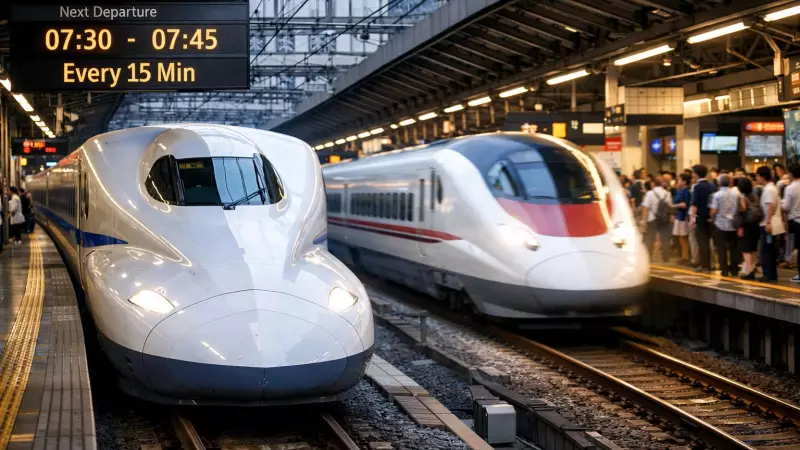
India's ambitious Mumbai-Ahmedabad High-Speed Rail (MAHSR) corridor, the nation's first bullet train project, is set to revolutionize inter-city travel with high-frequency services from its inception. Railway Minister Ashwini Vaishnaw announced on Friday that during peak hours, trains will initially run at intervals of 15 to 20 minutes, with plans to increase frequency based on passenger demand.
Peak-Hour Frequency and Future Plans
Addressing reporters at Rail Bhawan on January 2, 2026, Minister Vaishnaw outlined the operational blueprint for the landmark project. He stated that the initial service pattern would feature a bullet train departing every 15-20 minutes during busy periods. The vision, however, extends further. "When the MAHSR corridor becomes fully operational, services will run every 15–20 minutes during peak hours. There is also planning to reduce the interval to 10 minutes based on traffic demand. This will mark the beginning of a new transport system in the country," the Minister explained.
This phased approach to frequency enhancement ensures that the service capacity aligns with evolving ridership, promising a seamless and efficient travel experience that could see trains arriving every ten minutes at peak times.
Economic Impact and Transformative Connectivity
Vaishnaw emphasized the project's significant economic ripple effects, describing it as having a strong integration and multiplier effect on the Indian economy. The core promise of the bullet train is a drastic reduction in travel time, shrinking the journey between Mumbai and Ahmedabad to under two hours.
He painted a vivid picture of the new possibilities: "Suppose you board the bullet train from Surat in the morning after breakfast, travel to Mumbai for work, and return to Surat in the evening. This kind of seamless connectivity will become possible." This day-commute scenario between major economic hubs is poised to unlock unprecedented regional development and productivity.
The minister also highlighted the project's role in job creation, noting that approximately one lakh people have benefited, either directly or indirectly, through employment generated during the ongoing construction phase.
Project Milestone: Tunnel Breakthrough Achieved
The announcement on service frequency coincided with a major engineering achievement for the project. On the same Friday, the corridor marked a significant milestone with the breakthrough of a mountain tunnel in Maharashtra's Palghar district.
This tunnel is part of a larger network of eight mountain tunnels currently under construction for the project. Seven of these tunnels are located in Maharashtra, and one is in Gujarat. The successful breakthrough demonstrates steady progress on the ground.
In a key reassurance for potential passengers, Minister Vaishnaw affirmed that the fare for the Mumbai-Ahmedabad bullet train service would be affordable for the middle class, ensuring broad accessibility to this state-of-the-art transport system.
The combination of high frequency, reduced travel time, and affordable fares positions the MAHSR corridor as a transformative infrastructure project, set to redefine mobility and economic integration in one of India's busiest corridors.