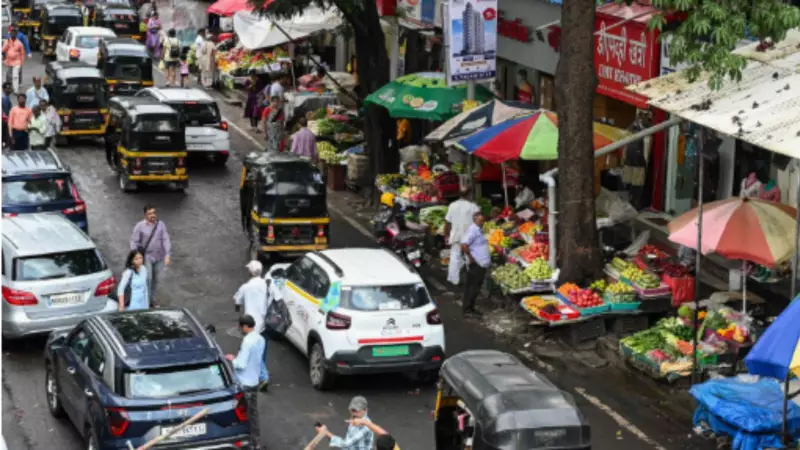
With Mumbai's civic elections scheduled for January 15, the persistent problem of illegal street vendors occupying public footpaths and roads has emerged as a critical urban issue affecting millions of citizens daily.
A Decade-Long Policy Paralysis
Despite the enactment of the Street Vendors (Protection of Livelihood and Regulations of Street Vending) Act in 2014, the Brihanmumbai Municipal Corporation (BMC) has failed to implement a concrete hawking policy. The legislation mandated the formation of local Town Vending Committees (TVCs) to regulate vending zones and manage pitches. Following the Act, the BMC received an overwhelming 99,435 applications from vendors seeking legal hawking pitches, each proposed to be one square meter in size.
However, nearly ten years later, the policy remains in draft stage. Civic officials attribute the delay to the pandemic and the absence of an elected body since 2022. "The draft was formulated in 2020, but the outbreak stalled implementation. We need elected corporators to consult stakeholders and finalize it," explained a BMC official. The Bombay High Court's 2024 directive to form TVCs also awaits the election of new civic representatives.
The Scale of Encroachment and Conflicting Data
The scale of the issue is vast, with official figures painting only a partial picture. According to BMC records, Mumbai has 32,415 registered hawkers. In stark contrast, data from hawkers' unions suggests the actual number is between 3.5 lakh to 4 lakh vendors operating across the city.
The impact on public infrastructure is severe. Mumbai's footpath network spans roughly 4,000 kilometers, and civic officials admit that more than 50% of it is encroached upon by hawkers. This occupation forces pedestrians onto roads, creating traffic bottlenecks and increasing the risk of accidents. Areas like Colaba Causeway, Siddharth Nagar, and Gajanan Marg are notably affected, with footpaths rendered "completely non-walkable and unsafe," as noted by former corporator Makarand Narwekar.
Election Promises and Temporary Drives
As the election campaign heats up, candidates are highlighting the hawker policy as a key agenda. BJP candidate Sandeep Patel, contesting for a second term, pledged to formulate a uniform policy. "My primary focus will be to free roads for pedestrians. In two years, I aim to make Siddharth Nagar and Gajanan Marg entirely hawker-free," Patel stated.
The BMC's enforcement actions have proven temporary. A "pedestrian-first" drive in March last year removed hawkers, but they returned within weeks. A similar removal of 67 illegal hawkers in Colaba in November was a reactive measure, underscoring the need for a permanent, policy-driven solution. Narwekar emphasized, "Only a proper policy can bring a permanent end to this issue."
The unresolved hawker crisis highlights a significant governance gap in India's financial capital. The lack of a regulatory framework continues to pit the livelihood needs of thousands of vendors against the right of way and safety of pedestrians, a balance the incoming civic body will be pressured to address immediately.