

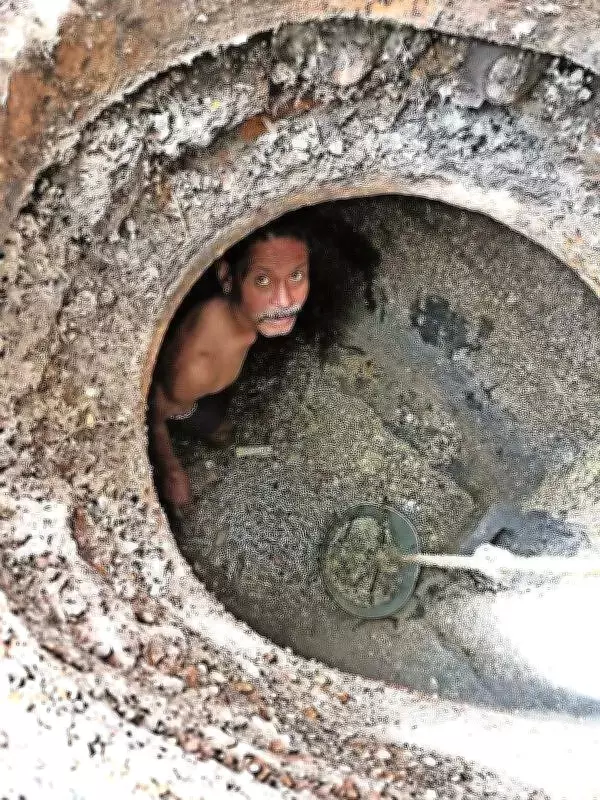
Nagpur: Sanitary worker Suresh Wankhede, who entered a manhole to clear a blockage, is not an isolated case. He is among 546 such workers routinely pushed into hazardous conditions to keep Nagpur's sewer network running. On April 21, Wankhede stepped nearly 6 feet down into a drain to remove a blockage — a stark reminder that despite being legally banned, manual scavenging continues on the ground.
Legal Prohibitions vs Ground Reality
The practice persists despite Supreme Court directives that strictly prohibit manual entry into sewers without safeguards. Gaps in infrastructure, limited mechanisation, and a civic system that falls back on human labour are to be blamed. Over the past two days, incidents reported by TOI have once again exposed this contradiction. A worker entering a manhole without safety gear, and officials admitting that several manholes cannot be cleaned mechanically, have raised serious concerns over enforcement. These are not exceptions — they reflect a systemic pattern.
A day after TOI highlighted the incident, mayor Neeta Thakre admitted that many manholes in the city cannot be cleaned mechanically, even as she assured that robotic devices would be introduced to reduce human intervention. The Shivaji Nagar incident (published by TOI on April 22) — where a worker entered a sewer after surface attempts failed — further underscored the limitations of existing systems. The chokage was eventually cleared using a suction machine, but only after manual entry already occurred. The Nagpur Municipal Corporation (NMC) issued show-cause notices to staff, while corporator Abhijeet Jha flagged the violation, intensifying scrutiny over safety compliance and accountability.

Scale of Dependence on Manual Labour
At the operational level, the scale of dependence on manual labour is significant. The NMC has deployed 546 sanitary workers across zones to tackle sewer blockages, especially in areas beyond the reach of machines. Each zone has around 50 workers tasked with clearing blocked sewer lines in narrow lanes, encroached conservancy paths, and densely-populated localities. Mechanisation, often projected as the solution, remains limited. The civic body currently has access to 15 suction-cum-jetting machines — 7 hired on rent by the solid waste management department and 8 funded by the state government. Additionally, NMC's workshop department operates 5 such vehicles, down from 9 after older units were scrapped.
"Even where machines exist, their effectiveness is restricted. Only a few small-capacity vehicles can navigate inner lanes, and even these fail in extremely narrow stretches between houses. In such cases, pipes are extended up to 40 feet — beyond which manual intervention becomes unavoidable," said an official privy to the situation.
Urban Constraints and Systemic Failures
Urban constraints further compound the issue. "Encroachments on conservancy lanes, unplanned expansion, and ageing sewer infrastructure have created pockets where mechanised cleaning is simply not feasible," said the official. In these areas, workers are often compelled to step in — frequently under pressure to restore blocked lines quickly and prevent overflows, admitted one of the sanitary workers deployed for the job. To bridge the gap, NMC is planning to procure 5 additional machines on rent, with monthly costs ranging from Rs 24,000 to Rs 80,000 depending on capacity. However, officials privately admit that even this may not fully eliminate the need for manual intervention.
The contradiction remains stark. While law prohibits manual scavenging, the ground reality reveals a system that continues to depend on it. Safety protocols are inconsistently followed, and workers often operate without essential protective gear or monitoring equipment. Unless structural issues — from encroachments to inadequate mechanisation and outdated sewer design — are addressed, Nagpur's sewer network will continue to rely on human intervention. And the ban on manual scavenging will remain, largely, on paper.

Key Statistics
- 546 sanitary workers deployed across NMC zones
- 50 workers per zone handling sewer blockages
- 15 suction-cum-jetting machines available
- 7 on rent (solid waste management department)
- 8 funded by state government
- 5 machines operated by NMC workshop (down from earlier 9)
- 40-foot limit for pipe extension beyond which manual intervention needed
- Several manholes cannot be cleaned mechanically, admits mayor Neeta Thakre
- Worker entered manhole without safety gear in recent incident
- Show-cause notices issued; violation flagged by corporator Abhijeet Jha
- NMC plans to hire 5 more machines (Rs 24,000 to Rs 80,000 per month)
Key issues: Encroachments, narrow lanes, ageing sewer network limiting mechanisation.





