

Noida Authorities Launch Crackdown on Overstaying Resident Welfare Associations
In a significant move targeting Resident Welfare Associations (RWAs) and Apartment Owners' Associations (AOAs) across the National Capital Region, the deputy registrar (firms, societies and chits) department has announced it will now directly oversee elections in societies where governing bodies have remained in office long after their mandated tenure. This pan-NCR crackdown comes in response to a surge in complaints from residents alleging that many RWAs have continued to wield power far beyond the prescribed two-year term, with some elections not conducted for over five to six years.
Widespread Problem in Rapidly Growing Urban Areas
Noida, Greater Noida, and Ghaziabad—regions that have witnessed explosive growth in urban housing—collectively host more than 1,000 registered RWAs and AOAs. These bodies are responsible for managing day-to-day affairs in most neighborhoods, including maintenance, security, civic services, and community facilities. However, they have increasingly become flashpoints for disputes over leadership, financial management, and decision-making processes.
"In the last eight months, elections were conducted in around 30 societies in Noida and 20 in Ghaziabad after our intervention," revealed Vaibhav Kumar, deputy registrar for the two districts. "In several cases, the RWAs had overstayed their tenure for years, creating governance vacuums and resident dissatisfaction."

Traditional Process Versus Administrative Intervention
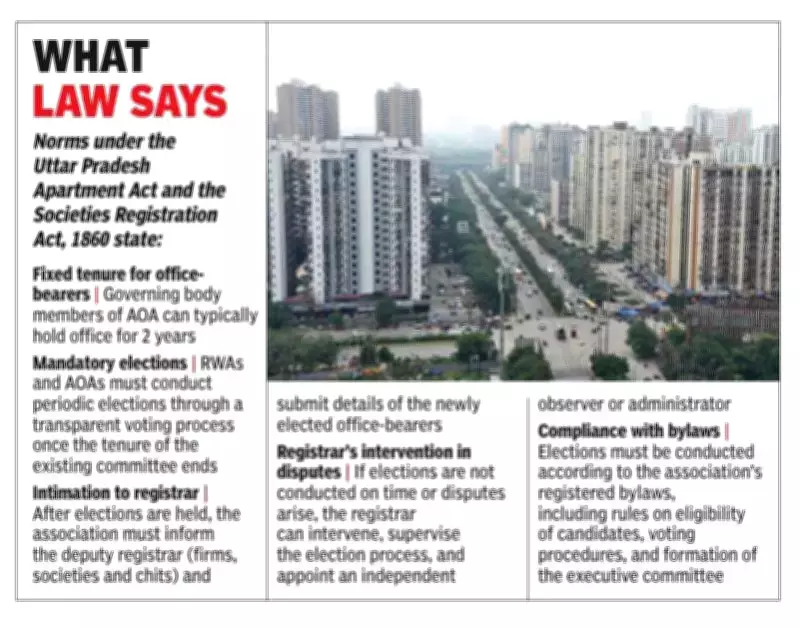
Typically, RWAs and AOAs conduct their own elections internally and simply inform the registrar's office once a new governing body is elected. However, when disputes arise or elections are repeatedly delayed—sometimes for years—the department now has the authority to step in and supervise the entire electoral process, including appointing independent observers to ensure fairness and transparency.
The scale of the problem becomes evident when examining specific cases. At Supertech Capetown, elections were finally held after a gap of five years. In Greater Noida's Gaur Homes and the Beta-2 sector, polls took place after more than seven years of delay. Perhaps most strikingly, residents of Alpha-1 sector recently filed a formal complaint with district administration alleging that RWA elections had not been conducted for nearly 15 years.
Resident Frustration and Administrative Response
"Every time elections are about to take place, the incumbent body creates pressure and the process gets stalled," explained Harinder Bhati of the Active Citizens Team, a residents' group advocating for democratic processes in housing societies. "We have repeatedly urged the administration to ensure polls are held this year to restore proper representation and accountability."
Officials are currently compiling a comprehensive list of societies where elections are overdue. Once finalized, polls will be conducted in strict accordance with provisions of the Uttar Pradesh Apartment Act and the Societies Registration Act of 1860. These regulations clearly state that members of an AOA governing body can hold office for only two consecutive years before requiring re-election.
Building on Previous Administrative Efforts
This fresh push for supervised elections follows an earlier audit conducted by the district administration last year, which sought to create a comprehensive database of housing societies in Noida and Greater Noida. That exercise meticulously recorded details of governing bodies and the dates of their last elections, directing societies that had exceeded their tenure to immediately initiate the electoral process.
In Ghaziabad, the district administration formed a high-level committee specifically to address disputes involving RWAs and AOAs after witnessing a significant surge in complaints during public hearings. Residents had raised numerous concerns ranging from delayed elections and alleged misconduct by office-bearers to poor maintenance of common areas, malfunctioning lifts, and misuse of authority by governing bodies.

Toward Greater Transparency and Accountability
Officials emphasize that this new round of supervised elections is fundamentally intended to bring greater transparency to these resident associations and ensure that the bodies meant to represent community interests remain genuinely accountable to their constituents. By intervening directly in electoral processes where governance has stagnated, authorities aim to restore democratic principles to housing society management across the NCR region.
The move represents a significant shift in how housing society governance is monitored and regulated, potentially setting precedents for other urban areas facing similar challenges with resident associations overstaying their mandated terms and failing to conduct regular, transparent elections.





