PMKVY Blacklist Uncovers Silent Classrooms and Legal Actions in Skill Training Scheme
The Government reports that approximately 27.08 lakh candidates across 38 sectors have received training under the flagship Pradhan Mantri Kaushal Vikas Yojana (PMKVY) 4.0, covering fields from beauty and wellness to aerospace and aviation. However, many of the classrooms and laboratories that once buzzed with activity, skilling up to 30 job aspirants simultaneously, now stand deserted, dusty, and devoid of life.
This desolation stems from their inclusion in a list of 178 skill training centers blacklisted by the Ministry of Skill Development and Entrepreneurship in October 2025. As initially disclosed by The Indian Express, the Ministry notified all state governments that these 178 Training Partners (TPs) and Training Centres (TCs) were found "non-adhering" to PMKVY norms, with "recovery of penalties" initiated.
Legal Actions and Broader Impact
On December 1, 2025, Skill Minister Jayant Chaudhary informed the Lok Sabha that, beyond blacklisting, 41 FIRs had been registered for "serious irregularities," such as falsification of attendance records. PMKVY courses typically span 300-600 hours, and the fallout has extended beyond the blacklisted centers to affect several Skill Sector Councils (SSCs)—autonomous industry-led bodies established by the National Skill Development Corporation (NSDC), which oversees PMKVY implementation. Among the 178 entities, 19 are operated by SSCs, including those in media, textile, tourism, and telecom sectors.

The NSDC did not respond to requests for comment. Officials explained that the blacklisting process involves multi-layered checks, including spot inspections, reviews, and show-cause notices. A 26-page "monitoring guidelines" document issued before PMKVY 4.0's launch in 2022 specifies that final decisions on blacklisting or suspension are made by NSDC's internal monitoring committee based on an "approved penalty grid." While the blacklisted centers represent a small fraction of the 12,840 functioning under PMKVY 4.0, field visits by The Indian Express highlight deeper structural challenges in the nationwide skilling initiative.
Case Studies of Blacklisted Centers
Food Photography in Hapur, Uttar Pradesh: In Bhaina Sadarpur village, the food photography lab established by Rajendra Singh Tomar, chairman of Sardar Singh Memorial College, appears abandoned. Tomar presented a show-cause notice dated May 20, 2025, citing that the center was "found closed on a working day" and suspended for six months. He shared a reply with photographs as evidence, claiming the inspector mistakenly uploaded images of another family-run school in the same village, not the college housing the skill center. According to Tomar, there was no response, and the center's name ended up on the blacklist. Faculty member Vikas Kumar noted that after the notice, they were instructed to "de-brand" the center, removing all PMKVY signages within three days, which he described as a wasteful exercise for their first attempt at training unemployed villagers.
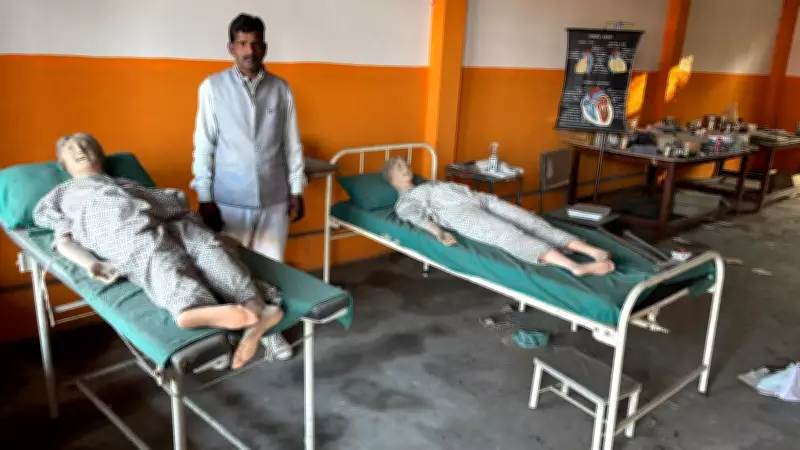
Basic Medical Assistance in Moradabad, Uttar Pradesh: Approximately 150 km away in Thakurdwara, another center inside Krishna Mahavidyalaya remains locked, with mannequins still on dummy hospital beds for basic medical skills training. Principal Dr. Radheshyam Singh reported that six batches had trained there with around 80% attendance. Project in-charge Rajesh Kumar pointed to a show-cause notice dated April 30, 2025, alleging "no candidates were present on the day of the visit, while attendance of 50 was marked." The notice from the Skill India Portal listed the discrepancy as "candidates not available" and warned of "strict action" if a reply was not provided within five days.

Handling Green Hydrogen in Mathura, Uttar Pradesh: The blacklist includes SSCs with de-commissioned centers, such as one run by the Skill Council for Green Jobs inside Shri Naval Kishore Pvt ITI in Mathura, which provided technical training in handling green hydrogen for industries. SSC CEO Arpit Sharma explained that on the inspection day, the trainer fell ill and left early, causing most candidates to depart. "We wrote to NSDC explaining that we had committed no fraud. But the status of the Mathura center has not been reversed. All our other centers are running smoothly," Sharma stated.
Widespread Complaints and Confusion
A common grievance across regions and sectors is the confusion sparked by NSDC including all 178 TPs and TCs in their communications to states, skill missions, and regional directors, as well as in the blacklist. Prashant Sharma, head of the All India Training Providers Association (AITPA), emphasized, "Only the name of the TC should have been mentioned where discrepancies were found. Now people think the entire TP, which may run hundreds of centers, has been blacklisted. As a result, TPs on the list are not getting work anywhere."
Delhi-Based Edujoin Training Foundation: Director Sudhanshu Parida shared an FIR filed against their center in Madhya Pradesh's Jhabua, alleging "misconduct, criminal misrepresentation and intimidation" and claiming attendance for 26 candidates was fraudulently recorded on the Aadhaar-based biometric system when the center was closed. Parida countered that the center had shut early around noon before Diwali, while inspectors arrived at 3:30 pm. "If there were no students that day, how would we have biometric attendance records? Because of this FIR, payments for our 11 other centers have stopped. With this blacklist circulated nationwide, we are unable to work anywhere," he lamented.
Assam Hotel Management Center: The owner of a TC training youth in hotel management reported it was shut on inspection day due to heavy flooding, leading to a suspension order and an FIR alleging fraud and forgery. "We haven't earned a penny from NSDC," the owner said, adding that their response cited "severe rain and flood conditions prevailing for nearly three months." The show-cause notice listed allegations that candidates were unavailable and two centers had been "merged" in one building, violating rules.
Systemic Challenges and Calls for Reform
Reflecting on their experience since PMKVY's launch in 2010, several NSDC partners identified a key challenge: ensuring daily attendance of four to six hours over months. Inspectors also noted low attendance and weak capacity-building as common issues across centers. One inspector, who regularly checks centers in Haryana and Rajasthan, observed, "We do not find enough trainees in classrooms. If they come, they leave soon and feel there is not much value in the diploma they receive. The scheme needs a reboot."
This investigation into the PMKVY blacklist reveals not only isolated cases of non-compliance but also broader operational hurdles and disputes over penalties, underscoring the need for enhanced oversight and transparency in India's skill development efforts.