Uttarakhand Transformation Dialogues 2026: Fostering Growth Through Digital Discourse
The Times of India’s flagship Uttarakhand Transformation Dialogues 2026 convened in Dehradun on Friday, uniting policymakers, academics, and industry leaders to strategize the state’s next growth phase. This high-profile event aimed to cultivate collaboration between government, industry, and civil society, with sessions delving into critical themes shaping Uttarakhand’s future.
Digital Education and Governance: A Fireside Chat with Anand Ranganathan
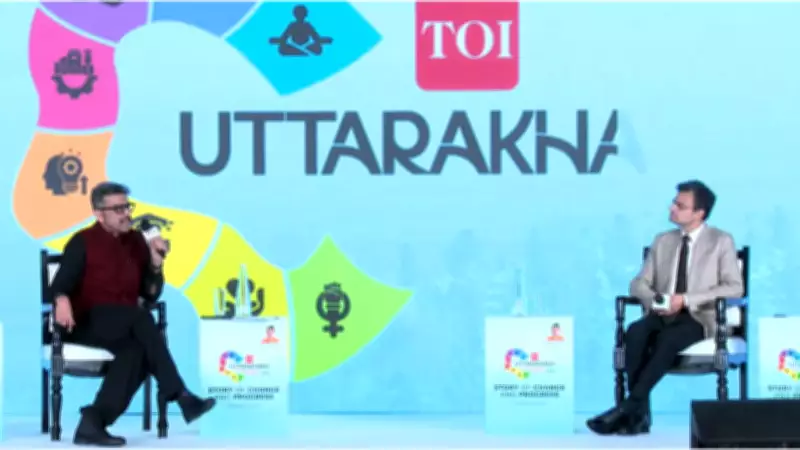
Among the key highlights was a fireside chat featuring renowned scientist and author Anand Ranganathan, who addressed the theme “Digital Education, Governance & Public Reason.” Ranganathan explored how digital platforms, education, and governance intersect to influence public discourse and policy outcomes, sparking a nuanced conversation on the evolution of public reasoning.
Public Reasoning in the Digital Age: A Noisy Democracy Preferred
Opening the discussion, the moderator questioned whether public reasoning has expanded or contracted in the digital era. Ranganathan responded unequivocally, stating, “It has certainly increased. There is no two ways about it.” He contrasted today’s environment with the 1970s and 1980s, when limited avenues like writing letters to editors often led to frustration. Describing the current landscape as a “problem of plenty,” he noted that multiple platforms now allow voices to be heard, advocating for a noisy democracy over enforced silence despite potential disruptions from extremes.

Political Labels and Ideological Debates in India
The conversation shifted to whether society is becoming overly opinionated, forming views before facts. Ranganathan argued that political labels are often imposed rather than clearly defined, particularly in India where Western Left-Right distinctions blur. He remarked, “In India, one can perhaps define the Left, but it’s very difficult to define the Right. In fact, in many domains, I consider the BJP a left-wing party, economically, it is certainly left-wing.” He added that labels simplify arguments and foster a sense of ideological belonging, which he accepts in “the right spirit.”
Science as a Guide in Public Discourse
When asked about pressure to adopt popular positions over factual ones, Ranganathan emphasized his reliance on a scientific approach since 2008. “I have always looked at everything through the lens of science. If you do that, you can never go wrong,” he said. He acknowledged fluctuating public reactions, noting that people often praise or troll him based on alignment with their views, a daily occurrence in his experience.
Corruption, Selective Narratives, and Institutional Scrutiny
Addressing debates on judicial corruption in textbooks, Ranganathan stressed that institutions should not be shielded from scrutiny, citing acknowledgments by former Chief Justices. He urged for a “full picture” in education but cautioned against selective criticism. “If you talk about corruption, talk about it everywhere. Don’t be selective,” he said, pointing to its presence in politics, science, medicine, and sports. He also criticized media tendencies to portray current problems as unprecedented, advocating for data-driven comparisons across states and timeframes.
Digital Media, Misinformation, and Bias Correction
On digital media’s role in spreading information and misinformation, Ranganathan stated that eliminating misinformation entirely is unrealistic. He proposed exposure to diverse viewpoints as the best corrective, drawing parallels to children of civil servants who gain balanced understanding through mobility. “The only way to circumvent bias is to know the other opinion. Always read two newspapers,” he advised. He framed disagreement as healthy diversity, benefiting listeners through democratized digital media.

Uttarakhand’s Growth: Achievements and Structural Challenges
Focusing on Uttarakhand, Ranganathan presented a mix of achievements and concerns. The state’s GDP per capita exceeds the national average by about $1,000, with welfare schemes like toilets, bank accounts, tap water, and Ayushman cards reaching nearly 100% of targets. However, he emphasized the need for long-term planning over 15-20 years, beyond political cycles. Highlighting a “problem of plenty,” he noted that tourist arrivals at 6.5 million vastly outpace the state’s one million population.
He raised alarms about structural imbalances: 80% dependence on agriculture, yet 28% of cultivable land lost in 15 years due to construction, urbanization, and tourism, leading to a 15% decline in agricultural produce. “You are facing a situation where one sector is doing extremely well — but structural balance must be maintained,” he cautioned.
Digital Governance and the Role of Inclusive Dialogue
On governance, Ranganathan observed that digital information alone is insufficient. “You can provide all the digital information you want. But digital information is not interactive. You tend to pick solutions from those who praise you. Critics are often pushed aside,” he said, underscoring the necessity for inclusive dialogue to drive effective policy.
The Uttarakhand Transformation Dialogues also featured sessions with various personalities, focusing on culture, gender, and heritage as growth drivers, reinforcing the event’s comprehensive approach to state development.