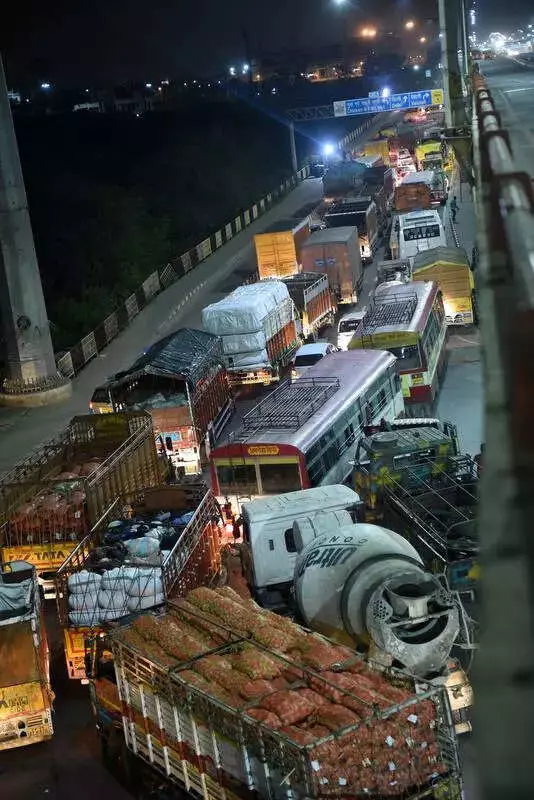
In a significant move, the Supreme Court of India has directly questioned the fundamental logic behind maintaining toll collection booths at Delhi's borders. The apex court highlighted that these toll points are causing severe traffic congestion and contributing to the worsening air pollution in the national capital.
Court's Directive and MCD's Response
The Supreme Court, in its latest order, has asked the Municipal Corporation of Delhi (MCD) to consider temporarily suspending the operation of its nine toll booths until the end of January. This period is when the Air Quality Index (AQI) is expected to see some improvement. The civic body has been given a week's time to respond to the court's query. MCD officials have stated they are awaiting the court's final directions and that a decision will be taken by the authority soon.
A History of Failed Measures
Over the years, multiple initiatives to decongest the city's 124 toll points have failed to yield results. In 2019, following earlier Supreme Court directions, MCD introduced a Radio Frequency Identification (RFID)-based toll collection system at 13 major border points like Ghazipur, Delhi–Meerut Expressway, and Rajokri. The aim was to enable automated payments and reduce bottlenecks. This was later supplemented by making RFID payments mandatory for commercial vehicles and introducing handheld devices at other plazas.

However, these technological interventions brought no noticeable relief. Even today, toll staff are frequently seen chasing vehicles to collect charges, leading to sudden chaos, long traffic snarls, and elevated pollution levels at these entry points.
Recent Steps and Pending Solutions
Recently, after receiving Supreme Court approval on October 1, MCD began imposing a green cess or Environment Compensation Charge (ECC) on vehicles carrying essential goods as well, claiming it would help streamline traffic. This measure too has made little difference, especially during peak hours.
Long-pending plans to widen the toll area at Ghazipur—after acquiring land from the Delhi Development Authority (DDA)—have also stalled. Currently, only two manually operated lanes are available for all vehicles, causing delays of over an hour during rush periods.
In a new proposal made in November, MCD suggested introducing a Multi-Lane Free-Flow (MLFF) tolling system to tackle chronic congestion. An official explained that the system uses automatic number plate recognition cameras along with RFID, allowing tolls to be deducted without vehicles stopping. This proposal is slated to be placed in the House meeting in January.
The Revenue Conundrum
The debate over tolls isn't new. In June, Union Minister Nitin Gadkari raised the issue of removing toll booths at Delhi's borders due to traffic and commuter inconvenience. MCD responded by stating that toll collection is a major revenue source. The civic body later wrote to the Delhi government seeking Rs 900 crore annually—with a 10% yearly increase—as compensation if toll collections were discontinued. The Delhi government is yet to decide on this matter.
Toll collection from commercial vehicles began in 2000 under the Delhi Municipal Corporation Act. While ECC proceeds go to a Delhi government escrow account for environmental projects, toll revenue remains a key income source for MCD's functioning.