

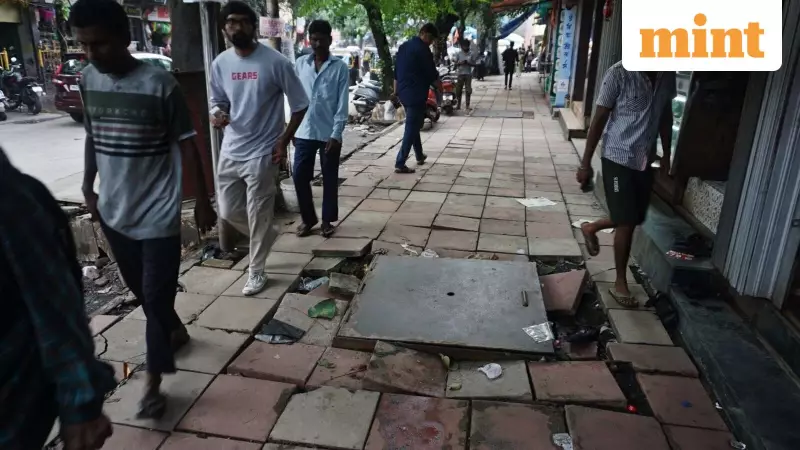
In urban India, the simple act of walking has transformed into a hazardous undertaking. A critical look at the state of footpaths across the nation reveals a profound failure in urban governance, one that prioritizes vehicles over people and has severe consequences for public safety, health, and the environment.
The Daily Obstacle Course for Pedestrians
Across Indian cities, from Delhi to Bengaluru, consistent and walkable footpaths are a rarity. Where sidewalks do exist, they are often broken, obstructed, or outright dangerous. Pedestrians are routinely forced to navigate a perilous maze of open manholes, dangling wires, construction debris, illegally parked cars, overflowing sewage, and unlit stretches. This turns a short walk into a daily exercise in risk management.
These hazardous conditions have a direct impact on mobility choices. Even citizens willing to walk are pushed towards using vehicles for short trips, not out of preference but out of a desire for self-preservation. The situation is so dire that social media is replete with evidence showcasing walking in Indian cities as an "extreme sport."

Doubling Deaths and a Systemic Design Failure
The consequences are stark and tragic. Pedestrian fatalities in India have doubled in just six years. While poor traffic discipline is often cited, this ignores the core issue: Indian cities are fundamentally designed in ways that make walking unsafe.
There is a stark imbalance in urban spending. Despite significant investments in transport infrastructure like metros and flyovers, the bulk of mobility expenditure prioritizes vehicles. This is illogical, given that pedestrians form the largest share of urban commuters. The problem is compounded for women, the elderly, and the differently-abled, for whom these conditions pose even greater threats.
This raises a fundamental question: why are Indian cities designed for cars rather than for their citizens? The issue runs deeper than mere maintenance; it's about intent and priority in urban planning.
From Faulty Planning to the Path Forward
The crisis is not due to a lack of planning, but the wrong kind of planning. Traditional Indian urban master planning is often rigid, focusing on zoning and long-term economic forecasts while treating cities as static entities. In reality, cities like Gurgaon evolved dynamically. What is needed is not micromanagement but strong governance of public spaces.
Building codes obsess over private plot regulations while neglecting the public realm. Consistent management of garbage removal, sidewalk maintenance, street lighting, and protecting green spaces is what creates livable cities. As seen in parts of Chennai, where walkability improved, the results are clear: motor vehicle use dropped, exhaust emissions reduced, and overall safety increased.
Making cities walkable is neither a luxury nor prohibitively expensive. It requires affordable interventions like continuous footpaths, safe crossings, and equitable road-space distribution. Indian cities, with their inherent density and compactness, are well-suited for walking. The transformation of cities like Amsterdam began with public outrage and sustained citizen pressure.
Ultimately, safe footpaths are a basic measure of how a society values human life. Walking is the most affordable, egalitarian, and fundamental mode of transport. Placing pedestrians at the center of urban design and management is not just a mobility solution; it is a necessity for healthier, safer, and more sustainable cities. The author, Pravin Kaushal, director-Mrikal and an IIT Kharagpur alumni, underscores this urgent need for a paradigm shift in how we build our urban environments.






