In a significant move to weed out ineligible beneficiaries, the Chandigarh administration's comprehensive survey has identified over 32,000 recipients under the National Food Security Act (NFSA) who are likely to lose their direct bank transfer (DBT) benefits. The exercise, which involved doorstep verification and data matching with central government databases, aims to ensure that welfare subsidies reach only the intended and eligible households.
Massive Data Matching Uncovers Suspect Beneficiaries
The process began in July 2025, when the central government shared data of 61,481 suspect beneficiaries with the Union Territory (UT) administration. This data was generated by matching the Ration Card Management System (RCMS) with databases of key central entities, including the Central Board of Direct Taxes (CBDT), the Central Board of Indirect Taxes and Customs, the Ministry of Corporate Affairs, the Ministry of Road Transport & Highways, and the PM-KISAN scheme.
The UT's food and supply department then undertook a rigorous two-month verification drive. Officials conducted physical doorstep visits and telephonic checks to validate the details of each suspect beneficiary against eight key indicators provided by the central government.

Key Indicators and Findings of Ineligibility
The verification was based on eight critical parameters: suspected status due to Aadhaar issues, duplicate beneficiaries, gross turnover, income group, individuals listed as company directors, land holdings, ration card members above 100 years of age, and vehicle ownership.
After the detailed field exercise, the administration found 34,555 beneficiaries to be clearly eligible. However, a major chunk, comprising 12,583 beneficiaries, could not be traced. "These 12,583 beneficiaries were also not found residing at their given address during the eKYC process and hence can be said to be not traceable," stated a UT official.
The survey pinpointed specific indicators as clear markers of ineligibility. These included an annual income above Rs 6,00,000, the status of being a duplicate beneficiary (especially inter-state duplicates), and problematic Aadhaar statuses such as deceased, cancelled, suspended, or inactive.
Breakdown of Beneficiaries Slated for Deletion
The data reveals a stark picture of ineligibility across different categories:
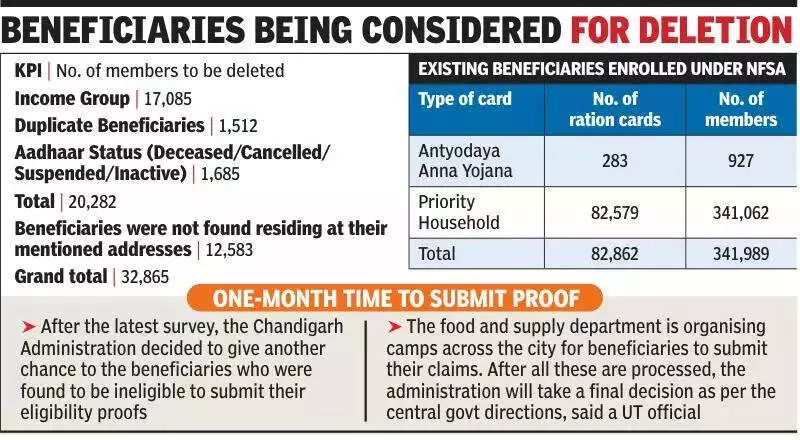
Income Criteria: A total of 5,006 beneficiaries were found ineligible based on income. As per Chandigarh's NFSA rules, a household with a gross annual income exceeding Rs 1.5 lakh is ineligible. This decision rendered the entire family of these beneficiaries ineligible. These 5,006 beneficiaries belonged to 4,283 unique ration cards, encompassing 17,085 family members.
Duplicate Beneficiaries: The survey identified 1,512 beneficiaries as ineligible due to being duplicate entries.
Aadhaar Status: Another 1,685 beneficiaries were flagged due to their Aadhaar status being deceased, cancelled, suspended, or inactive.
In summary, the total number of beneficiaries considered for deletion stands at 20,282. When combined with the 12,583 untraceable beneficiaries, the grand total reaches 32,865 individuals facing the potential termination of NFSA DBT benefits.
Current NFSA Enrollment and a Final Chance
Currently, Chandigarh has a total of 82,862 ration cards covering 341,989 members under the NFSA. This includes 283 cards under the Antyodaya Anna Yojana and 82,579 cards under the Priority Household category.
In a move demonstrating administrative flexibility, the Chandigarh Administration has decided to give a one-month window to those found ineligible to submit proof of their eligibility. The food and supply department is organizing camps across the city for beneficiaries to present their claims. "After all these are processed, the administration will take a final decision as per the central government directions," the UT official added.

This large-scale verification drive underscores the government's push towards creating a cleaner, more targeted public distribution system by leveraging technology and physical verification to plug leaks and ensure subsidies benefit the truly needy.