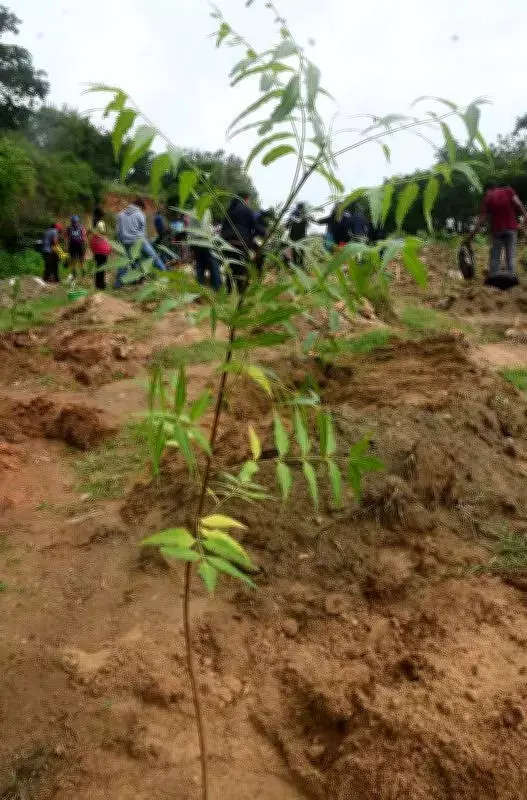
The Karnataka government has scaled down its ambitious afforestation target for this year after successfully planting 10 crore saplings over the last two monsoons. Citing a shortage of quality planting stock in forest nurseries, the government has reduced its annual target from 5 crore to 3 crore saplings. Despite this reduction, the state continues to emphasize improving survival rates and accountability in plantation drives.
Background of the Afforestation Drive
Two years ago, amid concerns over declining green cover, the Karnataka government set a goal of planting five crore saplings annually as part of a broader plan to raise 25 crore saplings by 2028. The annual target was achieved in the first two years through large-scale drives during successive monsoons, supported by institutions, NGOs, and volunteers. However, this year, the government acknowledged constraints in nursery capacity and seedling availability, leading to the reduced target.
Reasons for the Reduction
Forest Minister Eshwar Khandre, speaking at a workshop on heatwave preparedness in Bengaluru last week, explained the decision. "We have been planting five crore saplings over the past two years. But this year, we have decided to reduce the number to 3 crore saplings," he said, adding that the focus would remain on ensuring better survival and growth rather than merely meeting numerical targets. Officials attribute the shortfall primarily to the depletion of nursery stock. According to forest department sources, most surplus saplings available in nurseries were exhausted during the initial two years of intensive planting. Raising fresh, high-quality seedlings requires time, and officials indicated it could take one to two years to replenish stocks adequately. In some instances, particularly in parts of the Kalyana Karnataka region last year, the department even sourced plants from Rajahmundry in neighboring Andhra Pradesh to meet targets.

New Strategy Focuses on Quality
The government is recalibrating its strategy. Khandre pointed out: "There is a renewed emphasis on planting taller and more robust saplings, which are believed to have a higher chance of survival, particularly in challenging climatic conditions." Referring to survival rates, the minister said official estimates place them between 80% and 85%. "I would not admit these figures. But even if you reduce this percentage by another 10%, our saplings' success rate is definitely at around 70-75%. In urban areas like Bengaluru, the survival rate has been above 90%, and we have been mulling taking up planting of 10 crore saplings in Bengaluru alone to address the intense heatwave conditions that all of us are facing," he explained.
Future Plans and Accountability
The government aims to improve accountability in plantation drives by monitoring survival rates more rigorously. This includes using geotagging and regular audits to ensure that planted saplings are maintained and nurtured. The focus on quality over quantity is expected to yield better long-term results in increasing green cover across the state.