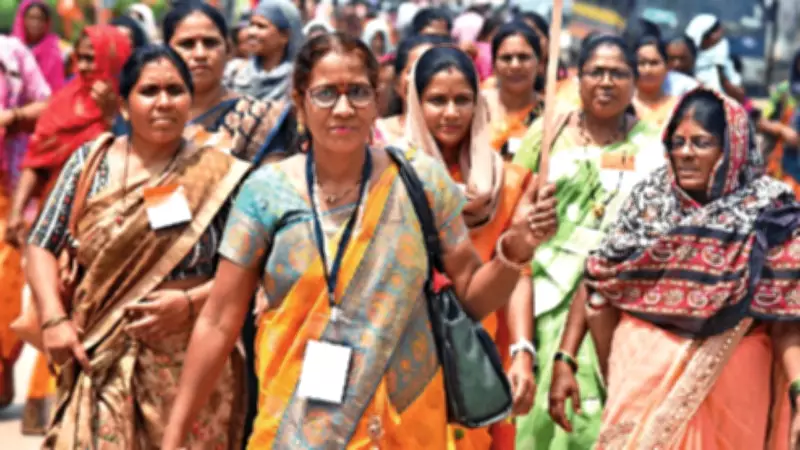
Maharashtra's Flagship Women's Welfare Scheme Grapples with Implementation Challenges
The Mukhyamantri Majhi Ladki Bahin Yojana, a landmark initiative aimed at empowering underprivileged women in Maharashtra, is facing significant operational hurdles. Launched in July 2024, the scheme provides a monthly stipend of ₹1,500 to eligible women aged 21 to 65 from families with an annual income below ₹2.5 lakh. However, mandatory e-KYC verification processes have created barriers for many intended beneficiaries, leading to widespread frustration and financial uncertainty.
Technical Glitches and Documentation Issues Hinder Access
Lata Khade, an anganwadi worker who actively promoted the scheme and helped enroll hundreds of women, now finds herself unable to receive her own payments. "Despite having all my documents in order, technical glitches and non-uploading issues during e-KYC have left me without the last three months' payouts," she explained. Her experience is not isolated; thousands of women across the state are racing against the March 31 deadline to complete verification and avoid being dropped from the program.
The situation is particularly dire for women like Savita Gaikwad, 45, from Patil Estate slums, who hasn't received payment since October due to illiteracy and lack of access to a smartphone. "I wish there were physical offices where I could submit my documents directly," she lamented. Similarly, sugar cane cutter Savitra Ankushe, 52, was allegedly cheated by an e-Seva Kendra employee and has yet to receive any stipend.

Substantial Drop in Beneficiary Numbers Following Verification
Initial enrollment under the Ladki Bahin scheme reached approximately 2.47 crore women. However, after the Mahayuti government returned to power and implemented rigorous e-KYC checks, the number of beneficiaries has plummeted. Early figures for 2025-26 indicate only 1.8 crore women remain eligible, with a staggering 86 lakh removed for failing to meet criteria such as state residency, age limits, or income thresholds.
A government source clarified the ongoing process: "The e-KYC verification will continue until March 31, after which final beneficiary numbers will be confirmed. Depending on the outcome, adjustments to scheme funding can be made through supplementary demands presented during legislative sessions."
Confusing Questions and Administrative Delays Add to Woes
Officials acknowledge that poorly designed e-KYC questions have contributed to the confusion. One particularly problematic question used double-negative phrasing—"No one in your family works for the government, right?"—leading many women to fill out forms incorrectly. Authorities have now granted a three-week window for corrections, but the damage has already been done for many.
Pushpalata, another beneficiary, highlighted the uncertainty surrounding payment schedules: "The delay in funds and lack of a fixed disbursement timeframe creates constant anxiety for those who depend on this support."
Continuity Assured Amid Budget Adjustments
Despite the reduction in beneficiaries, the Ladki Bahin scheme remains the highest-funded program under the Women and Child Development department. The 2025-26 budget allocates ₹29,570 crore, slightly lower than the previous year's ₹32,470 crore, as noted in the State Economic Survey presented during the current legislative session.
Chief Minister and Finance Minister Devendra Fadnavis confirmed in the recent state budget that the scheme "will continue," though he declined to comment on potential increases to the stipend amount or the duration of funding—a critical concern for all recipients.
Mixed Experiences Highlight Scheme's Impact and Shortcomings
For some women, the scheme has been transformative. Ashwini Bandewar, a 33-year-old single mother of two who works as a waste picker and in hospitality, described the stipend as a lifeline. "Most of my earnings go toward school fees and daily expenses. When I started receiving ₹1,500 monthly, I decided to save it for emergencies or my children's education," she shared.
Conversely, Tai Waghmode, a divorcee struggling to make ends meet, expressed disappointment: "I am fighting to survive day-to-day. This scheme has made no tangible impact on my life so far."

Scheme Overview and Eligibility Criteria
- Introduced in July 2024, the Ladki Bahin scheme provides unconditional monthly cash transfers of ₹1,500 to eligible women.
- Exclusions apply to women whose families own four-wheeler vehicles, have government employment, or bear income-tax obligations.
- As one of India's largest unconditional cash transfer programs, it allows beneficiaries full discretion over how funds are used.
- The initiative initially raised high expectations among economically weaker sections, hoping it would alleviate household financial pressures.
- Post-election changes in administrative interpretation have led to increased delays and exclusions, sidelining many eligible women.
The Mukhyamantri Majhi Ladki Bahin Yojana stands at a critical juncture, balancing its ambitious welfare goals against practical implementation challenges. With the March 31 deadline looming, the state government faces mounting pressure to streamline processes and ensure that financial aid reaches those who need it most.