

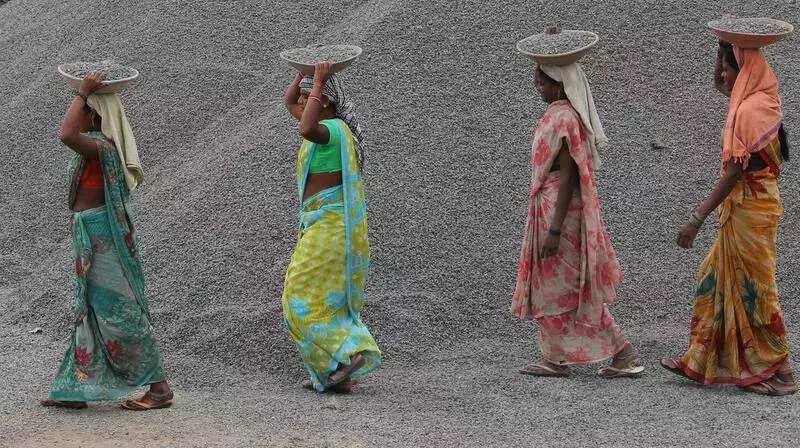
In a significant development for rural employment in Uttar Pradesh, the Mainpuri district has emerged as the top performer in the state under the revamped rural jobs guarantee scheme. The district, a stronghold of the Samajwadi Party, has recorded the highest number of households completing the full 100 days of work in the current financial year.
Mainpuri Sets the Benchmark in Rural Employment
Recent data from the ongoing 2025-26 fiscal year reveals that 5,205 households in Mainpuri have completed 100 days of employment under the scheme, now known as the Viksit Bharat Guarantee for Rozgar and Ajeevika Mission (Gramin) or VB-G RAM G. This former bastion of SP patriarch Mulayam Singh Yadav, currently represented by MP Dimple Yadav, has generated a substantial 520,500 person-days of employment so far this year.
This achievement represents approximately 6% of the total 87,268 households across the state that have reached this mandated employment benchmark. The 100-day guarantee is a critical legal safety net, designed to strengthen rural livelihoods by providing assured work during agricultural lean seasons or droughts, thereby reducing distress migration to cities.

Administrative Push Trumps Political Lines
The success in Mainpuri underscores a crucial insight: outcomes on the ground are driven by a combination of strong administrative implementation and genuine local demand, rather than political affiliation alone. Following Mainpuri, the districts of Gorakhpur and Azamgarh secured the next highest spots.
Gorakhpur, the home turf of Chief Minister Yogi Adityanath, saw 4,894 households completing 100 days of work, generating 489,400 person-days. Azamgarh, another SP bastion, recorded 4,468 households reaching the mark, with 446,800 person-days of employment created.
A block-wise breakdown highlights where work was concentrated:
- Mainpuri: Bewar block led with 1,674 households, followed by Kishni (1,149) and Mainpuri block (825).
- Gorakhpur: Khajani block was top with 775 households, followed by Uruwa (549) and Gola (493).
- Azamgarh: Azamatgarh (454), Sathiyaon (451), and Lalganj (434) blocks performed best.
Contrasting Performances Across Key Districts
The data also reveals stark contrasts with other politically significant districts. Varanasi, the parliamentary constituency of Prime Minister Narendra Modi, registered only 293 households achieving the 100-day employment mark.
More strikingly, Baghpat, the epicenter of Jat politics and the base of Jayant Chaudhary's Rashtriya Lok Dal, did not have a single household completing 100 days of work under the scheme this fiscal year. Similarly, the highly urbanized districts of Gautam Buddha Nagar and Ghaziabad also reported no households reaching the benchmark, reflecting the scheme's targeted focus on rural areas.
The performance metrics indicate that the effective rollout and uptake of the employment guarantee mission depend heavily on local administrative machinery and the agrarian economic profile of a region, setting a clear precedent for other districts to follow.






