Vidarbha's Transformative River-Linking Project Gains Momentum
The ambitious Wainganga–Nalganga river-linking initiative, which promises to fundamentally reshape the irrigation landscape across eight districts in Maharashtra's Vidarbha region, is steadily advancing through the necessary regulatory clearances. Officials from the Vidarbha Irrigation Development Corporation (VIDC) have expressed strong confidence that physical construction work could commence on the ground within the coming year.
Accelerated Approvals and Project Details
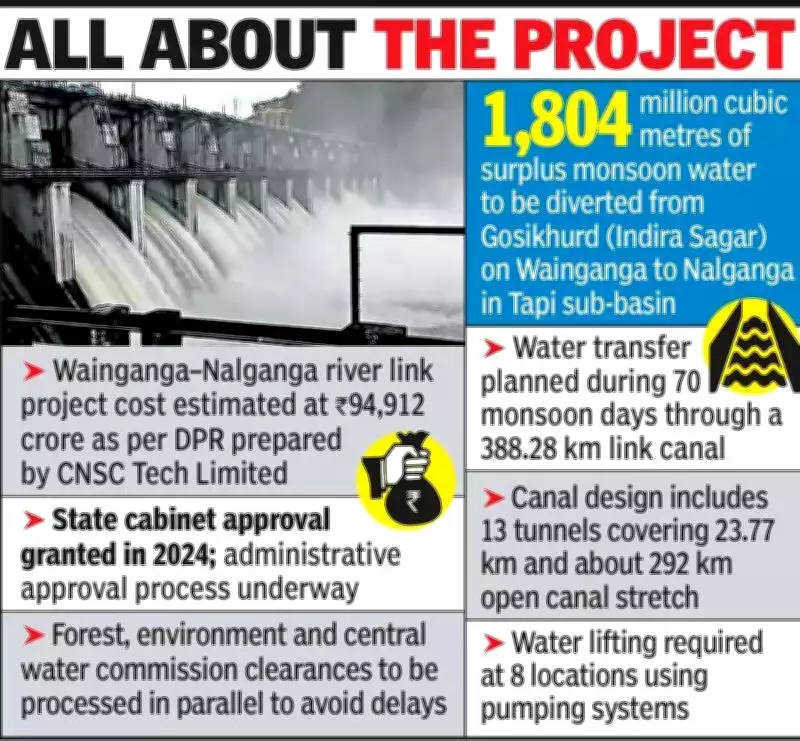
The approval process has been significantly accelerated to enable the commencement of actual construction work within this calendar year, according to VIDC officials. This major infrastructure project received formal approval from the Maharashtra state cabinet in 2024. A comprehensive detailed project report, valued at a staggering Rs 94,912 crore, was meticulously prepared by CNSC Tech Limited and is currently under administrative review. Notably, the initial estimated cost for the project was pegged at Rs 87,342.86 crore.
Chief Minister Devendra Fadnavis has placed this transformative scheme on high priority, personally overseeing and reviewing its progress at regular intervals. In a strategic move to expedite implementation, officials plan to pursue crucial forest and environmental clearances in parallel with the submission of the detailed proposal to the Central Water Commission in the coming months. This parallel processing is designed to save valuable time and prevent unnecessary delays.

Engineering Scope and Agricultural Impact
The core engineering plan involves diverting a substantial 1,804 million cubic metres of surplus monsoon water from the Gosikhurd (Indira Sagar) national project on the Wainganga River to the Nalganga River in the Tapi sub-basin. This massive water transfer, scheduled to occur over approximately 70 monsoon days each year, is projected to bring a remarkable 4,04,281 hectares of agricultural land under reliable irrigation. The beneficiary districts include Bhandara, Nagpur, Wardha, Amravati, Yavatmal, Akola, Washim, and Buldhana.
Beyond agriculture, the project is engineered to significantly bolster domestic water supply and meet growing industrial demands across the region. The proposed infrastructure includes an extensive 388.28-kilometre link canal system. This network will feature 13 tunnels with a combined length of 23.77 kilometres and approximately 292 kilometres of open canal. To manage elevation changes, water will be lifted at eight specific locations using powerful pumping stations.
Storage Infrastructure and Viability
To ensure a regulated and consistent water supply, especially for the critical rabi (winter) cropping season, the project design incorporates the creation of 50 storage reservoirs. This includes heightening 10 out of 18 existing reservoirs and constructing 32 entirely new reservoirs from the ground up. Additionally, three existing projects—Lower Wardha, Katepurna, and Nalganga—will be integrated and function as key storage structures within the overall system.
Technical and economic viability studies conducted by the Nashik Hydrology Project, which were submitted last year, have conclusively affirmed that the ambitious plan is both technically sound and economically feasible. The project also makes dedicated provisions for urban and industrial needs, allocating 80 million cubic metres for domestic use and 139 million cubic metres for industrial requirements along the canal corridor.
A Vision for Transformation
VIDC officials have hailed the Wainganga–Nalganga project as a plan with the "capacity to transform districts historically starved of irrigation." They reiterated that if all administrative and regulatory procedures continue to proceed as per the current accelerated schedule, "work on the ground can realistically start within a year," marking the beginning of a new era for water security and agricultural prosperity in Vidarbha.