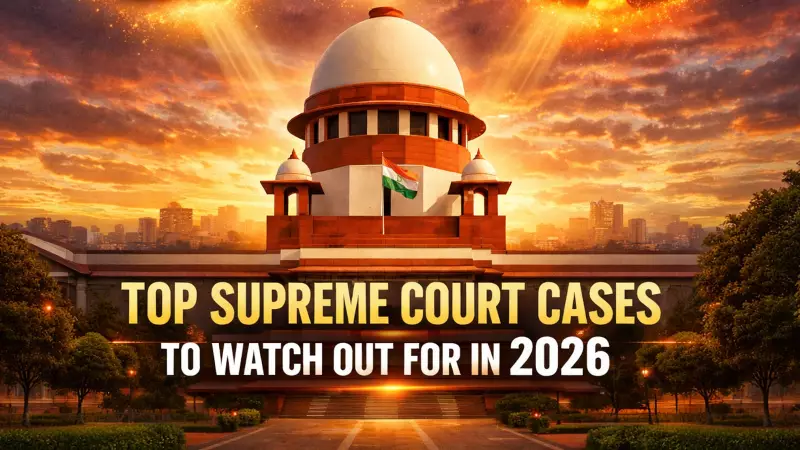
The Supreme Court of India is poised for a landmark year in 2026, with its docket filled with cases that will test the nation's constitutional fabric, electoral integrity, and social policies. These hearings, scheduled to commence from January, will deliberate on issues ranging from personal freedoms and judicial independence to economic regulations and animal welfare, with judgments likely to have profound legal and societal repercussions.
Constitutional Challenges and Social Legislation
A significant batch of cases involves direct challenges to newly enacted laws by Parliament and various state assemblies. At the forefront is the constitutional challenge to the Promotion and Regulation of Online Gaming Act, 2025. The petitioner, Head Digital Works Pvt Ltd, has contested Parliament's authority to impose a blanket ban on real-money online games. The company is specifically challenging sections 14, 15, and 16 of the Act, which govern investigation and enforcement, and has sought interim relief to protect games of skill like rummy and poker.
Similarly, the apex court will hear stay applications in a cluster of petitions questioning the validity of anti-conversion laws enacted by states including Madhya Pradesh, Gujarat, Uttar Pradesh, Uttarakhand, and Haryana. The NGO Citizens for Justice and Peace has argued for urgency, citing recent amendments that have made these laws more stringent. Notably, provisions of these laws have already been stayed by the High Courts of Gujarat and Madhya Pradesh.
Another crucial constitutional test will be against Section 152 of the Bharatiya Nyaya Sanhita (BNS). A petition filed by retired Army officer S G Vombatkere contends that this provision effectively resurrects the colonial-era sedition law under a new name, threatening free speech and dissent.
Electoral Integrity and Judicial Accountability
The Court's calendar is heavy with cases that touch upon the core of India's democratic processes. A key hearing will address petitions challenging the Chief Election Commissioner and Other Election Commissioners Act, 2023. Petitioners, including Dr. Jaya Thakur and the Association for Democratic Reforms (ADR), argue that the Act violates the Supreme Court's 2023 judgment in the Anoop Baranwal case by removing the Chief Justice of India from the selection committee for Election Commissioners.
Connected to electoral fairness are petitions challenging the Election Commission's decision to undertake a Special Intensive Revision (SIR) of electoral rolls in several states, including Bihar. Although the Court refused an earlier plea to stay the exercise, the final hearing will scrutinize the constitutional validity of the process.
In an unprecedented matter concerning the judiciary itself, the Supreme Court will hear a writ petition filed by Allahabad High Court judge Justice Yashwant Varma. The petition challenges the legal validity of a committee set up by the Lok Sabha Speaker to probe corruption charges against him, following the discovery of unaccounted cash at his official residence during a fire in March 2025. Justice Varma has alleged that due procedure was not followed in constituting the probe panel.
Socio-Economic and Civic Issues
The Court's purview extends to critical socio-economic disputes. One such case involves the potential eviction of over 50,000 people from 4,365 alleged encroachments on 29 acres of Indian Railways land in localities like Gafoor Basti, Dholak Basti, and Indira Nagar. The Supreme Court had earlier stayed a High Court eviction order, citing humanitarian concerns, and the matter is slated for hearing in January 2026.
In the corporate sphere, the Court is dealing with a PIL concerning allegations of a "builder-bank nexus" and round-tripping of funds involving Indiabulls Housing Finance Limited (now Sammaan Capital Limited). The Court has directed the CBI Director to decide on forming a Special Investigation Team (SIT) to probe the alleged quid-pro-quo arrangements in corporate loans.
On the civic front, a suo motu case on stray dog management will be heard. The Court, after modifying an earlier harsh order, will now consider objections to the Municipal Corporation of Delhi's rules on January 7, 2026. The issue gained national attention after media reports highlighted fatal attacks by stray dogs in Delhi-NCR.
Finally, the Waqf Amendment Act 2025 remains under judicial scrutiny. In September 2025, the Supreme Court passed an interim order staying several provisions, including those granting district collectors wide powers over Waqf properties and mandating a five-year practice of Islam to create a Waqf. The court also capped non-Muslim appointments to Waqf councils.
The outcomes of these ten critical cases will undoubtedly shape the legal and social landscape of India for years to come, making 2026 a defining year for the Supreme Court.