AIBE 21 Syllabus 2026: Comprehensive Guide to the All India Bar Examination
The All India Bar Examination (AIBE) is a crucial post-enrolment assessment designed for law graduates who have already registered with a State Bar Council. Unlike traditional law school exams that focus heavily on theoretical knowledge, the AIBE evaluates candidates' practical ability to apply legal principles in real-world scenarios. This examination serves as a vital quality control mechanism, ensuring that new advocates entering the legal profession meet established standards of competence and professionalism.
Purpose and Significance of the AIBE
Introduced to enhance professionalism within the legal community, the AIBE acts as a rigorous checkpoint for aspiring advocates. Successful candidates are awarded the Certificate of Practice by the Bar Council of India, granting them the authority to practice law in courts across the nation. This certification is essential for building a credible legal career and upholding the integrity of the judicial system.
AIBE 2026 Exam Pattern: Key Details
The format of the AIBE examination has remained largely consistent over the years. It is conducted as a multiple-choice question (MCQ) test, covering fundamental areas of law taught in Indian law schools. The primary features of the exam pattern are outlined below:
- Examination Mode: Computer-based or offline, as announced by the Bar Council of India (BCI)
- Duration: 3 hours and 30 minutes
- Total Questions: 100
- Question Format: Multiple-choice questions
- Marks per Question: 1 mark
- Negative Marking: None
Since incorrect answers do not incur penalties, candidates are encouraged to attempt all questions, fostering a comprehensive approach to the test.
Subject-Wise Distribution of Questions
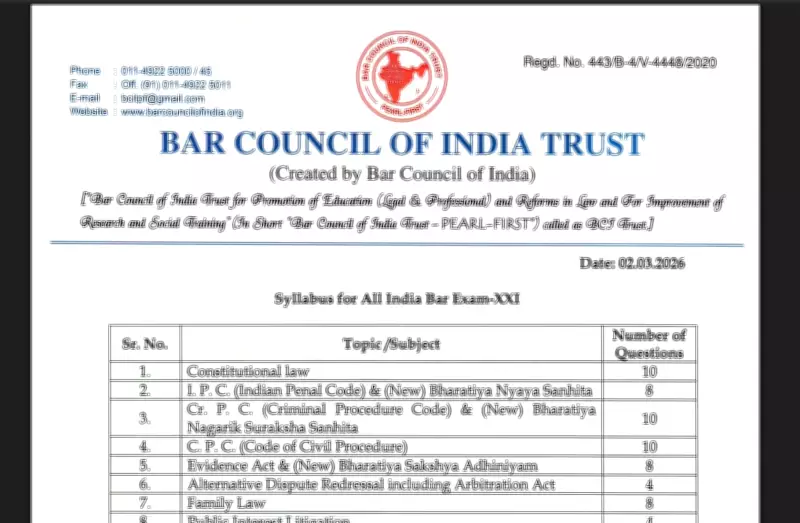
The AIBE question paper encompasses a diverse range of core legal subjects, reflecting the breadth of knowledge required for legal practice. The approximate distribution of questions across various subjects is as follows:
- Constitutional Law: 10 questions
- Indian Penal Code (IPC): 8 questions
- Criminal Procedure Code (CrPC): 10 questions
- Code of Civil Procedure (CPC): 10 questions
- Evidence Act: 8 questions
- Alternative Dispute Resolution (ADR): 4 questions
- Family Law: 8 questions
- Public Interest Litigation: 4 questions
- Administrative Law: 3 questions
- Professional Ethics & BCI Rules: 4 questions
- Company Law: 2 questions
- Environmental Law: 2 questions
- Cyber Law: 2 questions
- Labour & Industrial Law: 4 questions
- Law of Tort: 5 questions
- Taxation Law: 4 questions
- Contract, Property & Negotiable Instruments: 8 questions
- Land Acquisition Law: 2 questions
- Intellectual Property Laws: 2 questions
This distribution ensures a balanced assessment of candidates' understanding across both substantive and procedural aspects of law.
AIBE 2026 Syllabus: Core Legal Subjects
The syllabus for AIBE 21 broadly aligns with the core subjects covered in three-year and five-year LLB programs across India. Candidates are expected to demonstrate a foundational grasp of the following key areas:
- Constitutional Law
- Criminal Law
- Civil Law
- Procedural Laws
- Evidence Law
- Contract Law
- Tort Law
- Family Law
- Environmental Law
- Administrative Law
- Alternative Dispute Resolution
The emphasis is not on intricate theoretical interpretations but on practical application and basic conceptual clarity, preparing candidates for the realities of legal practice.
AIBE Passing Criteria and Certification
The Bar Council of India has established minimum qualifying marks to ensure a standard level of proficiency. The criteria are as follows:
- General and Other Categories: 45%
- SC/ST/OBC Categories: 40%
Candidates who achieve these marks are declared qualified and receive the Certificate of Practice, formally authorizing them to practice law in courts throughout India. This certification is a milestone in a legal professional's journey, symbolizing their readiness to contribute to the justice system.
For detailed resources, candidates can access the official AIBE 21 syllabus through provided links, ensuring thorough preparation for this pivotal examination.