

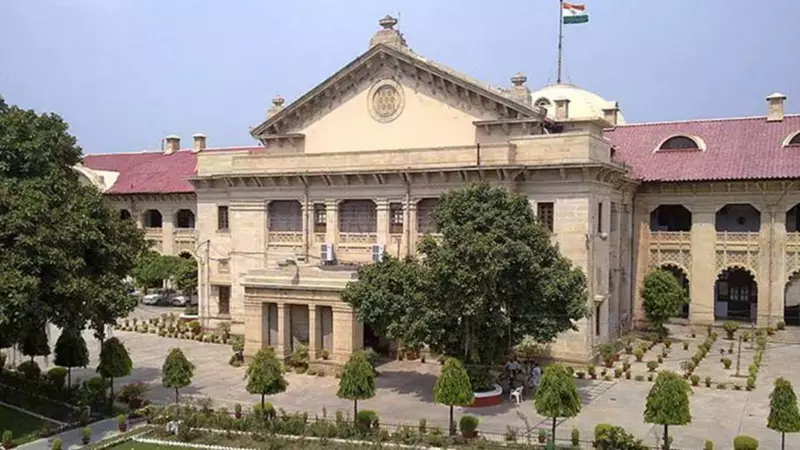
The Allahabad High Court has firmly dismissed a criminal appeal that sought the withdrawal of a prosecution case registered under the stringent Scheduled Castes and Scheduled Tribes (Prevention of Atrocities) Act. The court upheld a trial court's order, finding no illegality in its decision to reject an application for withdrawal filed by the Public Prosecutor.
Court Upholds Independent Scrutiny in Sensitive Cases
In a significant order passed on December 11, 2025, a bench of the High Court emphasized that a mere expression of intention by the state government to withdraw a prosecution case does not bind the judiciary. The court stated that such an expression cannot dilute the mandatory requirement of independent scrutiny by both the public prosecutor and the court, especially in cases under the SC/ST Act.
The High Court observed that the learned Special Judge had meticulously examined the First Information Report (FIR), statements recorded under Section 161 of the Criminal Procedure Code (CrPC), and other material on record. This material indicated serious allegations of cheating and caste-based abuses. Upon this consideration, the HC found no merit, perversity, or impropriety in the trial court's earlier order and consequently dismissed the appeal.

Background of the Kushinagar Case
The case originates from Seorahi police station in Kushinagar district, Uttar Pradesh, and dates back to 2020. According to the court's order, the complainant, a woman belonging to a Scheduled Caste, alleged that she paid Rs 80,000 to the accused, Chhote Lal Kushwaha and three others, for arranging a visa and employment in Qatar for her husband.
The visa was reportedly handed over on January 1, 2019, with validity until February 23, 2019. The complainant claimed the visa was unusable and that the accused failed to return the money despite repeated demands. The situation escalated on May 5, 2020, when she visited the accused to demand her money back. She alleged that she was subjected to caste-based abuses and threats by Kushwaha and his family members.
Based on her complaint, a case was registered under charges of cheating, criminal intimidation, relevant sections of the Disaster Management Act, and various provisions of the SC/ST Act. After investigation, a chargesheet was filed against the four accused men.
The Withdrawal Attempt and Legal Battle
In a twist in January 2024, following a communication from the Uttar Pradesh state government, the Public Prosecutor moved an application under Section 321 of the CrPC seeking permission to withdraw the prosecution. The grounds cited were that the case did not merit further continuation.
However, the complainant strongly opposed this move, filing objections before the trial court. She contended that the prosecution was instituted only after her application under Section 156(3) CrPC was allowed. She argued that the allegations clearly disclosed offences against a member of a Scheduled Caste, which warranted a full trial.
The Special Judge (SC/ST Act) in Kushinagar rejected the withdrawal application on July 26, 2024. The judge noted that the case involved serious prima facie allegations of cheating and caste-based insults, supported by material on record. The court held that withdrawing the case was not in public interest. It also observed that the Public Prosecutor's application did not reflect an independent application of mind, rendering it unsustainable.
Challenging this order, the accused filed a criminal appeal under Section 14-A(1) of the SC/ST Act in July 2024. Their counsel argued that contradictions in the complainant's statements were overlooked, the visa issued was valid, and her husband chose not to travel voluntarily. They also contended that since the Governor and state government had directed the withdrawal, the trial court should have allowed it.

High Court's Final Ruling and Directive
The Allahabad High Court rejected all these arguments. It stated that the trial court's approach in scrutinizing the prima facie evidence, considering the rights of the complainant, and noting the lack of independent reasoning by the Public Prosecutor was fully in consonance with principles laid down by the Supreme Court of India.
The bench concluded, "This Court finds no illegality, perversity, or impropriety in the order... The rejection of the application under Section 321 CrPC warrants no interference." The appeal was dismissed as devoid of merit.
However, acknowledging that the sessions trial has been pending since 2020, the High Court issued a directive for its expedited conclusion. It expected the trial court to conclude the proceedings preferably within six months, in accordance with the law, without granting unnecessary adjournments to either party. With this observation, the criminal appeal was disposed of.





