

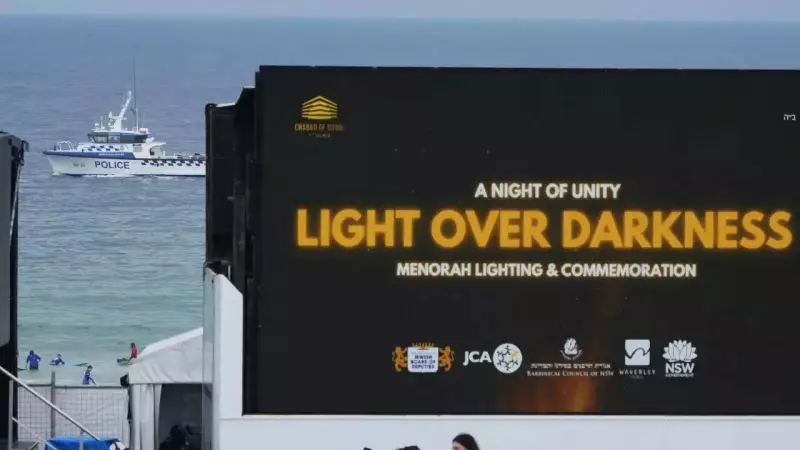
In a powerful display of grief and solidarity, thousands of Australians gathered at Sydney's iconic Bondi Beach on Sunday evening under heavy police security. The solemn vigil marked one week since a horrific attack by two gunmen targeting a Jewish festival claimed 15 lives and wounded many others.
National Day of Reflection and Political Tensions
The commemoration, declared a national Day of Reflection, drew more than 10,000 people, including Prime Minister Anthony Albanese, former PMs John Howard and Scott Morrison, and Governor-General Sam Mostyn. The event, however, was not without political undercurrents. The crowd booed PM Albanese, while opposition leader Sussan Ley, who promised to reverse the government's recognition of a Palestinian state, was cheered.
David Ossip, President of the New South Wales Jewish Board of Deputies, addressed the crowd, calling the attack the "nadir of antisemitism in our country." The sentiment was echoed in a message from King Charles III, delivered by the Governor-General, expressing that he and Queen Camilla were "appalled and saddened." Israeli PM Benjamin Netanyahu had earlier criticised Albanese, alleging that the call for a Palestinian state "pours fuel on the antisemitic fire."

Victims Remembered and Nation Unites
Images of the victims, aged 10 to 87, were projected during the ceremony. The youngest victim, a 10-year-old girl born in Australia to Ukrainian parents, was honoured with a rendition of "Waltzing Matilda," a song her parents considered the most Australian name they knew.
At 6:47 p.m., the exact moment the massacre unfolded a week prior, the nation united in a minute of silence. People across Australia lit candles in their homes, while television and radio networks fell silent. In Sydney, flags flew at half-mast on the Harbour Bridge, and government buildings were illuminated in yellow as a symbol of solidarity.
Earlier on Sunday, Indigenous leaders held a traditional smoking ceremony at the Bondi Pavilion, where a growing makeshift memorial of flowers and messages will be cleared on Monday. Governor-General Mostyn also joined hundreds of women and girls dressed in white to lay flowers at the invitation of the National Council of Jewish Women.
Government Response: Scrutiny and New Laws
The attack has galvanised Australian governments into action. Prime Minister Albanese announced a review of federal law enforcement and intelligence agencies, noting the attack was inspired by the Islamic State group. An emergency meeting of federal and state leaders committed to tightening the nation's already strict gun laws, including measures to limit the number of firearms an individual can own.
The suspect, 24-year-old Naveed Akram, was shot by police and now faces 15 counts of murder and 40 counts of causing harm with intent to murder. His father, 50-year-old Sajid Akram, was shot dead at the scene. It was revealed that Sajid Akram legally owned six guns, including the weapons used in the attack.
The security response has also faced scrutiny, with criticism that first responders were armed only with pistols against assailants with shotguns and rifles. Two police officers were critically wounded. On Sunday, police presence around Bondi was bolstered with officers carrying rifles.
Alex Ryvchin of the Executive Council of Australian Jewry stated that victims' families felt "tragically, unforgivably let down" by government failures to combat rising antisemitism since the Israel-Hamas war began in 2023. In response, the New South Wales state parliament will sit on Monday to debate new draft laws on hate speech and gun control.
As of Sunday, 13 of those wounded in the Bondi attack remained hospitalised in Sydney, a sombre reminder of the nation's worst mass shooting since 1996.






