

Kolkata Court Sends Bangladeshi Shooting Suspects to Jail, NIA Granted Permission for Interrogation
In a significant development in the cross-border investigation into the murder of Bangladeshi youth activist Osman Hadi, a Kolkata court has sent the two primary suspects to judicial custody. Faisal Karim Masud, aged 37, and his accomplice Alamgir Hossain, aged 34, were produced before the Bidhannagar court by the Bengal Special Task Force (STF) on Sunday after completing fourteen days in police custody.
Court Orders and Legal Proceedings
The court has remanded both accused individuals to prison until April 2, 2026, marking a crucial step in the legal process. Additionally, the court has granted permission to the National Investigation Agency (NIA) to question Masud and Hossain at the Dum Dum correctional home. This move underscores the seriousness of the case and the involvement of multiple investigative bodies.
Furthermore, the court approved the STF's application to invoke Sections 16 and 18 of the Unlawful Activities (Prevention) Act (UAPA) against the accused. These sections pertain to terrorist acts and conspiracy, respectively, indicating that the authorities are treating this as a case with potential terror links.

Suspect's Controversial Claims and Denial
While being transported back to jail, Faisal Karim Masud made startling allegations to reporters. He vehemently denied any involvement in the killing of Osman Hadi and suggested that the murder could be a plot orchestrated by Bangladeshi political groups Jamaat-e-Islami and the Bangladesh Nationalist Party (BNP).
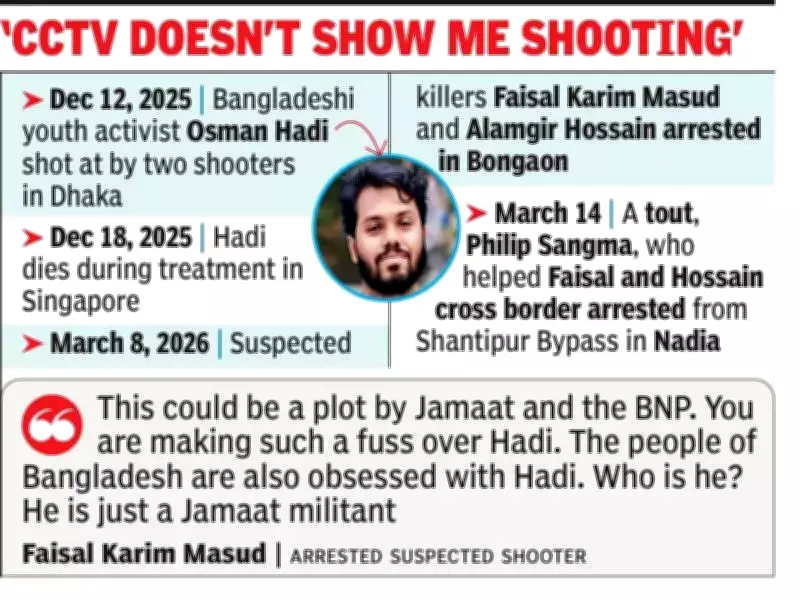
"This could be a plot by Jamaat and the BNP," Masud stated. "You are making such a fuss over Hadi. The people of Bangladesh are also obsessed with Hadi. Who is he? He is just a Jamaat militant."
When confronted about the CCTV footage that allegedly shows him shooting at Hadi, Masud disputed its clarity, claiming, "It (the CCTV) did not show me shooting." This contradicts earlier findings by the Dhaka Metropolitan Police, which identified Masud as the key shooter in the attack on December 12, 2025, in Dhaka.
Background of the Case and Victim Profile
Osman Hadi, aged 32, was a lecturer at the University of Scholars in Dhaka and served as a spokesperson for the political platform Inqilab Mancha. He rose to prominence during the July 2024 uprising in Bangladesh, which ultimately led to the fall of the Sheikh Hasina government. Hadi was shot while campaigning in Dhaka and was subsequently airlifted to Singapore for medical treatment, where he succumbed to his injuries on December 18, 2025.
His assassination occurred during a highly charged political period in Bangladesh, sparking widespread protests and violence across the country. The incident has prompted Bangladeshi authorities to intensify efforts for the extradition of the accused individuals arrested in India, as part of an ongoing cross-border investigation.
Investigation Developments and Arrests
The Bengal STF arrested Faisal Karim Masud and Alamgir Hossain on March 8, 2026. Based on interrogations of the suspects and others involved, the STF subsequently arrested a Bangladeshi tout named Philip Sangma from the Shantipur Bypass in Nadia on March 14. Sangma is alleged to have assisted Masud and his accomplices in crossing the border into India.
Investigations reveal that Masud and Hossain entered India through the Meghalaya border and frequently changed their hideouts before reaching the border town, highlighting the complexities of the cross-border nature of this case.
Diplomatic Efforts and International Implications
Following the arrests, Bangladesh Police Inspector General Ali Hossain Fakir held a press conference in Dhaka on March 9, 2026. He announced that diplomatic efforts through the foreign ministries of India and Bangladesh are being intensified to repatriate the two accused persons. This underscores the international dimensions of the case and the collaborative efforts between the two nations to ensure justice.

The case continues to draw significant attention due to its political undertones and the cross-border legal challenges involved. With the NIA now authorized to interrogate the suspects and the UAPA invoked, the investigation is expected to delve deeper into the motives and networks behind this high-profile murder.





