

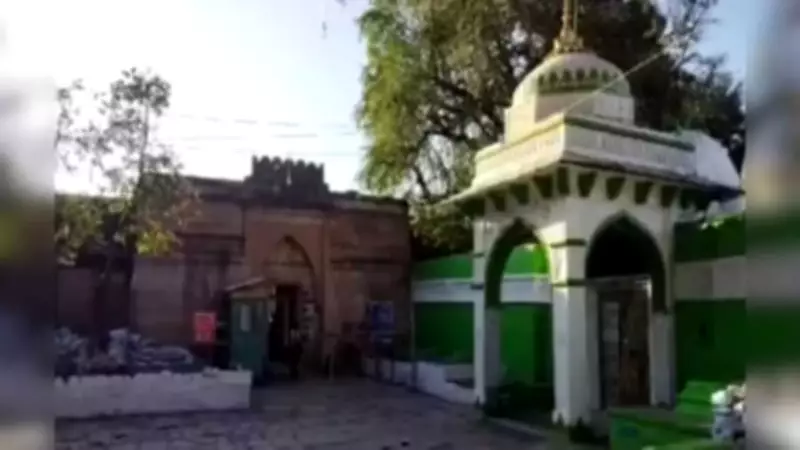
The Madhya Pradesh High Court on Wednesday heard arguments in the long-running dispute over the Bhojshala Temple-Kamal Maula Mosque Complex, with the Muslim side asserting that the site has historically been recorded as a mosque and that available records do not clearly establish the existence of a Saraswati temple built by Raja Bhoj, according to a PTI news agency report.
The complex, located in Dhar district and protected by the Archaeological Survey of India (ASI), is claimed by the Hindu community as a temple dedicated to Goddess Saraswati, while Muslims identify it as the Kamal Maula Mosque, an 11th-century structure.
Appearing before the Indore bench of Justices Vijay Kumar Shukla and Alok Awasthi, Qazi Moinuddin—who claims to be a descendant of Sufi saint Maulana Kamaluddin Chishti and the Sajjadanashin (spiritual head)—challenged two PILs filed by the Hindu community and individuals seeking exclusive worship rights for Hindus at the site.

The petitions filed by the Hindu party contend that Bhojshala is fundamentally a Saraswati temple.
Moinuddin’s counsel, Noor Ahmed Sheikh, argued that the site has long been documented as a mosque in revenue records and that his client’s family has historically held titles associated with it. He maintained that those linked to the management of the Kamal Maula Mosque have been in "continuous and peaceful occupation" of the complex. Citing principles of Muslim law, Sheikh submitted that functionaries such as the Sajjadanashin and Mutawalli—and their descendants—have legal rights to manage and use religious properties like mosques.
He further referred to the Ancient Monuments Preservation Act 1904, arguing that long-standing control of a property confers certain rights on those in charge.
Another counsel, Touseef Warsi, representing a local welfare society, alleged that the Hindu petitioners had made misleading historical claims. He told the court that existing sources do not clearly mention any Saraswati temple established by Raja Bhoj, the legendary king of the Parmar dynasty who ruled Dhar from 1010 to 1055.
Warsi further questioned the shifting stand of the ASI in related proceedings and raised objections to the methodology of the scientific survey conducted at the site in 2024, including videography practices.
The court will continue hearing the matter on Thursday.






