

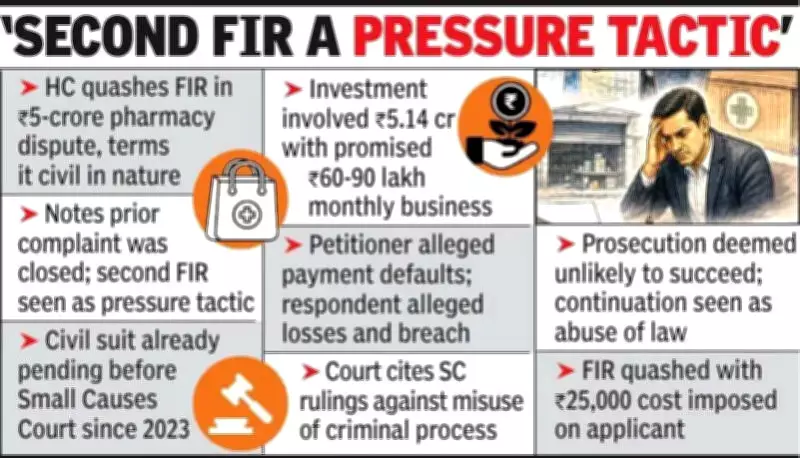
The Nagpur bench of the Bombay High Court recently quashed a cheating case arising from a Rs 5.14 crore pharmacy investment dispute, observing that a mere breach of contract cannot amount to a criminal offence unless fraudulent or dishonest intention is shown right from the beginning of the transaction.
Court's Ruling
Justice Vrushali Joshi set aside an FIR registered by Sitabuldi police against a city doctor for alleged cheating, criminal breach of trust, and criminal intimidation. The court ruled that the dispute was essentially of a civil nature and was already pending before a competent civil court.
Background of the Case
The case stemmed from a 2019 agreement in which the respondent and his associates invested over Rs 5.14 crore to run a pharmacy at a hospital. The agreement promised monthly business between Rs 60 lakh and Rs 90 lakh, with an 18% revenue share payable to the hospital owner. However, the complainant alleged financial losses, non-fulfilment of assurances, and the opening of a parallel pharmacy, eventually leading to the closure of the venture.

Petitioner's Arguments
The petitioner doctor, who filed the case through senior counsel Sunil Manohar along with Adil Mirza and Masood Sharif, argued that the complainant defaulted on agreed payments and breached contractual obligations. This prompted a civil suit for eviction, recovery of dues, and damages, filed in 2023, which remains pending. The court noted that an earlier complaint on the same issue was closed by the police, advising the parties to pursue civil remedies. Yet, a subsequent complaint led to the registration of the FIR.
Court's Observations
Calling this sequence surprising, the judge observed that the dispute between the petitioner and the third respondent is a civil litigation, and termed the second FIR an apparent arm-twisting tactic. Citing Supreme Court precedents, the court reiterated that the criminal process cannot be utilised for any oblique purpose, and proceedings should be quashed where chances of conviction are bleak and continuation would amount to an abuse of process.
No Evidence of Fraud
Rejecting the allegations of fraud, the court found no evidence of dishonest intent at the inception of the transaction. It noted that a formal Memorandum of Understanding (MoU) and subsequent agreements reflected a commercial arrangement. The court quashed the FIR against the petitioner, subject to a cost of Rs 25,000 to be deposited with the court's public welfare account within two weeks.






