Calcutta High Court Dismisses SC/ST Case Over 'Adarsha Sir' Remark
The Calcutta High Court has delivered a significant ruling, stating that addressing someone as 'Adarsha Sir', even in a sarcastic manner, does not qualify as an offence under the Scheduled Castes and Scheduled Tribes (Prevention of Atrocities) Act, 1989. This decision came on Wednesday as the court quashed a criminal complaint filed against the former Head of Department (HoD) of Sanskrit College and University.
Court's Reasoning on the Term 'Adarsha Sir'
In a detailed judgment, a single judge bench presided over by Justice Chaitali Chatterjee (Das) emphasized that the phrase 'Adarsha Sir' cannot be construed as derogatory towards a member of the Scheduled community. The court elaborated that the word 'adarsha' translates to 'ideal' in English, while 'sir' is universally recognized as a term of respect. Therefore, even if used sarcastically, the expression does not inherently carry any insult or humiliation based on caste identity.
Background of the Case and Allegations
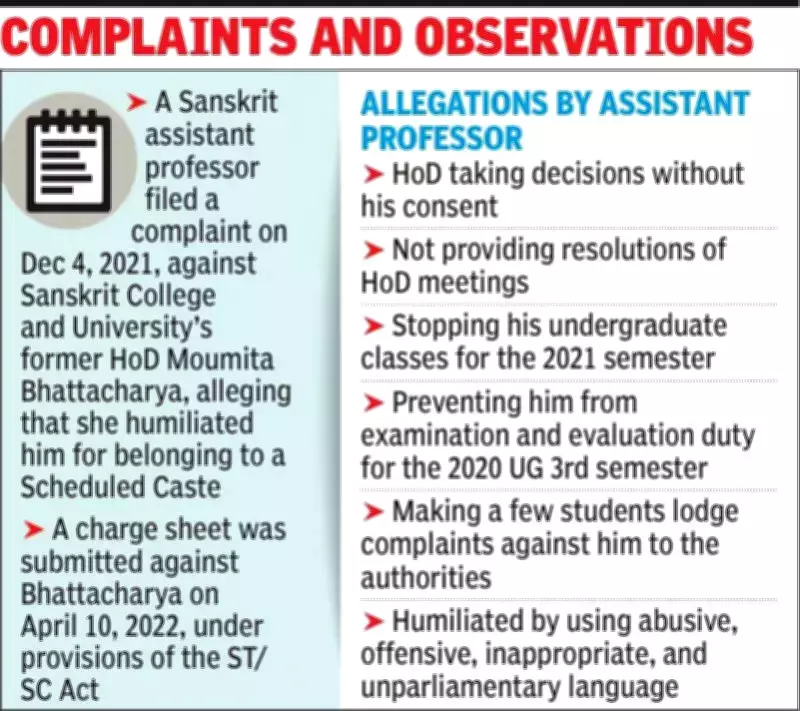
The case originated when Moumita Bhattacharya, the former HoD of Sanskrit at Sanskrit College and University, approached the High Court seeking to quash a 2021 case registered at the Amherst Street police station. The complaint was filed by an assistant professor of Sanskrit on December 4, 2021, who alleged that Bhattacharya had humiliated him due to his belonging to a Scheduled Caste.

The allegations in the First Information Report (FIR) included several instances of professional misconduct:
- Bhattacharya making decisions without the complainant's consent.
- Withholding resolutions from HoD meetings.
- Terminating his undergraduate classes for the 2021 semester.
- Barring him from examination and evaluation duties for the 2020 UG third semester.
- Encouraging students to file complaints against him with the authorities.
Additionally, the complainant claimed that during an online meeting, Bhattacharya used abusive, offensive, and unparliamentary language to humiliate him. In a statement before the magistrate, he further alleged that in 2019, Bhattacharya had humiliated and abused him by referring to him as 'lower caste' and denying him a desired recommendation. However, Justice Chatterjee noted that no formal complaint was lodged regarding this 2019 incident at the time.
Defense Arguments and Judicial Observations
Bhattacharya's legal representative argued that she was falsely implicated in the case due to personal grudges and ill motives. The defense stressed that to establish an offence under the SC/ST Act, it must be conclusively proven that the accused intentionally insulted or intimidated the victim with the specific intent to humiliate them in a public setting, solely because of their caste background.
Justice Chatterjee observed that the complainant's grievances primarily revolved around allegations of atrocity, misbehavior, and ill motivation directed at him as a member of the Scheduled Caste community. The judge pointed out that the complaint appeared to stem from professional jealousy, as it suggested Bhattacharya could not tolerate the advancement of a professor from the Scheduled Caste community.
Legal Precedent and Final Ruling
Citing Supreme Court orders, Justice Chatterjee reiterated a crucial legal principle: not all insults or intimidation towards a member of the Scheduled Castes or Scheduled Tribes amount to an offence under the 1989 Act. The offence is only established if such insult or intimidation is explicitly based on the victim's caste identity.
In this instance, the court found no evidence that the term 'Adarsha Sir' was used with the intent to humiliate the complainant on caste grounds. Consequently, the High Court quashed the complaint and the subsequent charge sheet filed against Bhattacharya on April 10, 2022, under the provisions of the SC/ST Act. This ruling underscores the necessity for clear, caste-based intent in prosecutions under the Act, safeguarding against misuse while upholding its protective purpose.