

Calcutta High Court Reinstates CRPF Constable, Criticizes Dismissal Based on Hearsay
The Calcutta High Court has delivered a significant ruling, reinstating a CRPF personnel from Karnataka who was dismissed for allegedly contracting a second marriage. The court, in its judgment on March 19, stated that the dismissal was purely "on the basis of hearsay and suspicion" and lacked substantive evidence.
Background of the Case
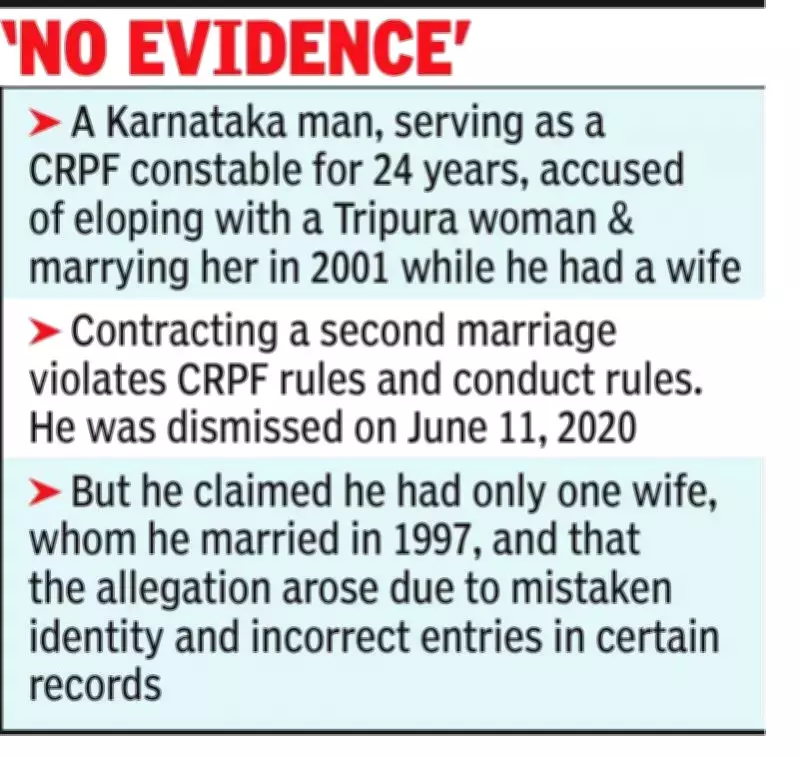
The constable, who had been serving with the CRPF for 24 years, was posted with the 165 Battalion in Tangasole, West Midnapore, when he faced dismissal on June 11, 2020. He was accused of eloping with a woman from Tripura and marrying her in 2001, while already having a wife from his 1997 marriage. Contracting a second marriage violates CRPF rules and conduct regulations, leading to his termination.
However, the constable maintained his innocence, claiming he had only one wife and that the allegations stemmed from mistaken identity and incorrect official entries. He argued that no criminal proceedings for bigamy were ever initiated against him, highlighting the lack of legal basis for the departmental action.

Legal Proceedings and Appeals
Following his dismissal, the constable pursued multiple appeals within the CRPF hierarchy. His initial appeal before the deputy IGP, CRPF, Range Yalahanka in Bangalore was rejected on September 29, 2020. A revisional application met the same fate on March 5, 2021. Undeterred, he filed a second appeal before a different authority, but this plea was also rejected on October 6, 2021.
With internal avenues exhausted, he moved the Calcutta High Court, seeking judicial review of the disciplinary action. The court noted that continuation of the proceedings would cause the personnel not only professional but also personal and emotional hardship, emphasizing the human impact of such cases.
Court's Rationale and Judgment
Justice Ajay Kumar Gupta, presiding over the case, acknowledged that the court does not sit as an appellate authority when exercising judicial review over disciplinary actions. However, he asserted that interference is warranted when findings are "perverse, based on no evidence, or in violation of settled principles of law."
The High Court critically examined the evidence presented in the departmental proceedings. It found that while holding the constable guilty of a second marriage, the proceedings relied solely on hearsay statements and police reports. There was no independent corroboration or proof of the essential ingredients required for a valid marriage, such as marriage certificates or witness testimonies.
"Such evidence, in the opinion of this court, falls short even of the standard required in departmental proceedings," Justice Gupta remarked, underscoring the insufficiency of the evidence. The court also addressed an additional accusation of submitting a fraudulent hostel subsidy, noting that since the constable had already been punished for this offense, he could not be penalized twice for the same crime.
Implications and Outcome
By reinstating the constable, the Calcutta High Court has set a precedent emphasizing the need for concrete evidence in disciplinary matters, particularly those involving personal allegations like marriage violations. The ruling highlights the judiciary's role in protecting individuals from arbitrary actions based on unsubstantiated claims.
This case serves as a reminder of the importance of due process and fair investigation in both governmental and organizational contexts, ensuring that decisions affecting careers and lives are grounded in fact rather than suspicion.






