Calcutta High Court Delivers Landmark Ruling on CAPF Medical Disqualifications
In a significant judicial intervention, the Calcutta High Court has firmly established that physical conditions such as sweaty palms, patchy hair loss, and certain birthmarks cannot serve as legitimate grounds to disqualify candidates for constable positions within the Central Armed Police Forces (CAPF). This ruling emerged from three separate cases where candidates were unjustly declared medically unfit, leading to the court mandating their appointments.
Case 1: Sweaty Palms and the Question of Nervous Instability
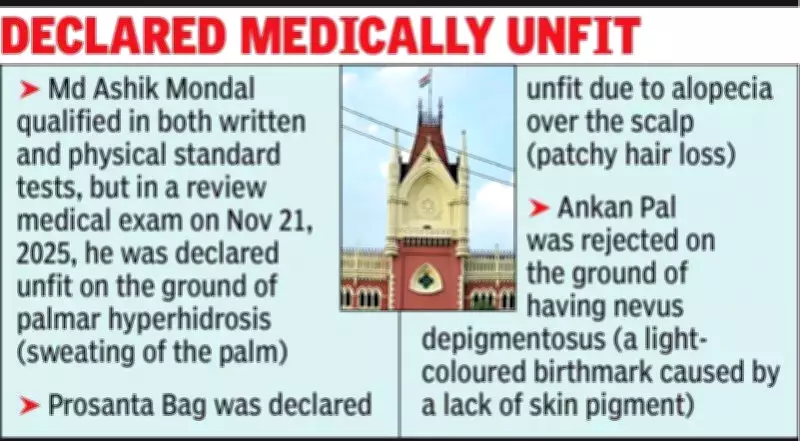
The first case centered on Md Ashik Mondal, who successfully cleared both the written and physical standard tests for a CAPF constable role. However, during a review medical examination on November 21, 2025, he was deemed unfit due to palmar hyperhidrosis, commonly known as excessive sweating of the palms. The authorities attributed this condition to nervous instability, citing Clause 6 (16) of the revised May 2015 medical guidelines, which permits rejection based on evidence of mental or nervous instability.
Justice Saugata Bhattacharyya, presiding over the case, critically examined this conclusion. The court noted a complete absence of conclusive medical findings to substantiate the claim that sweaty palms indicated nervous instability. Justice Bhattacharyya remarked that the disqualification appeared to be based on "surmise and conjecture" rather than solid evidence. Consequently, the application of Clause 6 (16) was declared "not tenable". The court directed the CAPF authorities to treat Ashik as medically fit and proceed with his appointment within two months, provided he meets all other eligibility criteria.
Case 2: Patchy Hair Loss Misclassified as Chronic Disease
In the second instance, Prosanta Bag faced disqualification after qualifying in the written and physical tests. A review medical exam on December 2, 2025, declared him unfit due to alopecia over the scalp, specifically identified as scarring alopecia. The authorities argued that this condition constituted a chronic disease, aligning with guidelines that list chronic ailments like tuberculosis, syphilis, rheumatoid arthritis, and hypertension as grounds for rejection.
However, subsequent expert medical opinions presented during the review process clarified that alopecia over the scalp cannot be accurately described as a chronic disease. Additional reports reinforced this view, stating that scarring alopecia does not qualify as a chronic condition. Justice Bhattacharyya, in his ruling on January 29, found the initial disqualification unjustified. The court ordered the authorities to declare Bag medically fit and appoint him to the constable post within eight weeks.
Case 3: Birthmark Misinterpretation Leads to Unfair Rejection
The third case involved Ankan Pal, whose candidature was rejected in early January based on the presence of nevus depigmentosus, a light-colored birthmark resulting from a lack of skin pigment. CAPF counsel contended that nevus conditions are valid grounds for medical disqualification. However, Justice Bhattacharyya considered a detailed report from the AIIMS Kalyani medical board, which provided crucial insights.
The medical board's report explicitly stated that the candidate's skin issue was not classified as dysplastic nevus syndrome. Instead, it was identified as nevus depigmentosus, which is non-heritable and non-progressive. Given this clarification, the court found no valid medical basis for the rejection. Justice Bhattacharyya directed the authorities to appoint Ankan within eight weeks, emphasizing the need for accurate medical assessments in recruitment processes.
Broader Implications and Judicial Directives
These three rulings collectively underscore the Calcutta High Court's commitment to ensuring fairness and precision in CAPF recruitment procedures. The court has highlighted several critical points:
- Evidence-Based Assessments: Medical disqualifications must be supported by conclusive and specific medical findings, not assumptions or conjectures.
- Accurate Classification: Conditions must be correctly classified according to established medical standards; mislabeling ailments like alopecia as chronic diseases is unacceptable.
- Individual Evaluation: Each case requires careful examination of expert medical opinions to avoid arbitrary rejections.
The court's directives mandate the CAPF authorities to appoint all three candidates within specified timelines, subject to their fulfilment of other eligibility conditions. This ruling is expected to set a precedent, promoting more transparent and equitable medical evaluations in future recruitment drives for armed forces and similar sectors.
By addressing these specific instances of overreach, the Calcutta High Court has reinforced the principle that recruitment decisions must be grounded in factual accuracy and medical integrity, safeguarding the rights of candidates against unfounded disqualifications.