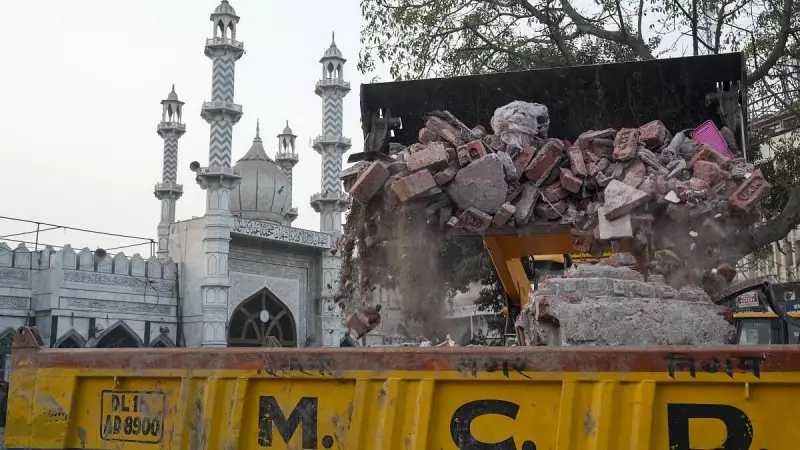
A tense silence enveloped the Turkman Gate area of central Delhi on Thursday, a stark contrast to the violence that erupted just a day earlier. Residents remained largely indoors, their locality under a virtual lockdown, hours after municipal authorities carried out a targeted demolition drive. The action, which saw several structures being razed, has sparked allegations of being a punitive measure following the communal clashes that broke out in the vicinity on Wednesday.
Demolition Drive Follows Night of Violence
The sequence of events began on Wednesday when a dispute over the installation of a religious flag escalated into a communal clash near the Turkman Gate area. The altercation involved stone-pelting, leaving several individuals injured and prompting a significant police response to control the situation. The area was eventually brought under control, but the atmosphere remained charged.
In a swift move the next morning, teams from the Delhi Development Authority (DDA), accompanied by a heavy police contingent, arrived in the locality. Officials stated the operation was aimed at removing illegal constructions and encroachments on public land. Using bulldozers and other equipment, the teams proceeded to demolish a number of structures, including some shops and walls.
The timing of the drive, coming merely hours after the violent clash, has raised serious questions and accusations from local residents and political groups. Many perceive it as a form of collective punishment targeting a specific community in the aftermath of the violence, rather than a routine administrative action.
Residents Describe Fear and Lockdown Conditions
For the people living in the narrow lanes of Turkman Gate, Thursday was a day of fear and uncertainty. Following the demolition, a palpable sense of apprehension kept most people inside their homes. Shop shutters remained down, and the usual bustling market activity was absent. The heavy police presence, while intended to maintain order, contributed to the lockdown-like environment.
Residents expressed their distress, claiming they were given little to no prior notice about the demolition. "They came early in the morning with bulldozers and police. We were not properly informed. This feels like action is being taken against us because of what happened yesterday," said one local shopkeeper who did not wish to be named.
Community leaders and activists have condemned the drive, arguing that such actions in the immediate wake of communal tension only serve to alienate citizens and deepen distrust. They have called for a transparent investigation into the violence and for rehabilitation if any legitimate structures were affected.
Official Stance and Lasting Implications
Authorities have firmly denied any link between the demolition and the previous day's violence. DDA officials maintained that the action was part of a pre-planned anti-encroachment exercise to clear public land. They asserted that the structures removed were illegally built and that due process was followed.
However, the optics and timing have fueled a major political debate. Opposition parties have slammed the ruling dispensation, accusing it of using bulldozers as an extra-legal tool for intimidation. This incident in Delhi adds to a growing national discourse on the use of demolition drives in areas recently affected by communal unrest.
The immediate consequences are clear: a traumatized local community, a further deterioration of police-public relations in the area, and a renewed spotlight on the protocols governing anti-encroachment drives. The long-term impact on social harmony in the historic Turkman Gate locality remains to be seen. The event underscores the delicate balance law enforcement must strike between maintaining order, executing administrative duties, and ensuring community confidence is not irreparably damaged.
As the dust settles from both the violence and the demolitions, the residents of Turkman Gate are left to pick up the pieces, hoping for peace and questioning the motives behind the sudden arrival of the bulldozers.