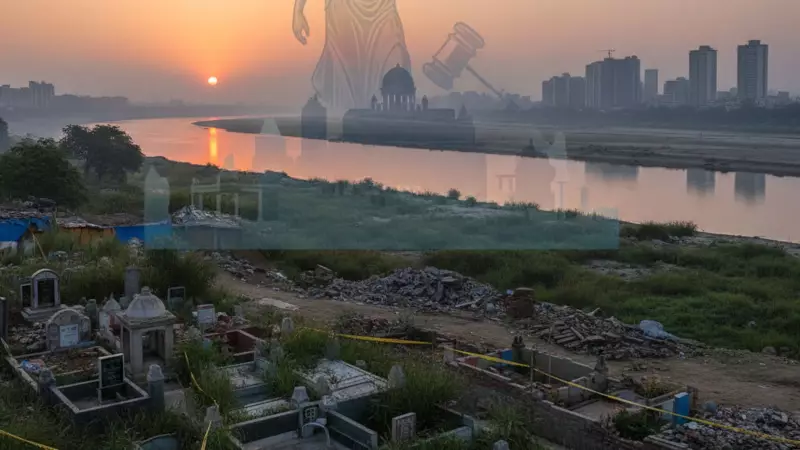
In a significant move to protect the ecologically fragile Yamuna floodplains, the Delhi High Court has issued a stern order prohibiting any person from living on the land and mandating the fencing of a graveyard area within a week. The bench, comprising Justices Pratibha M Singh and Mameet Pritam Singh Arora, passed the order on December 22, 2025, while hearing a petition against large-scale encroachments.
Court's Directives to Curb Encroachment
The court directed the Delhi Development Authority (DDA) and the Land and Development Office (L&DO) to immediately fence the identified graveyard area to prevent its further expansion. It explicitly stated that no new construction for residential purposes would be permitted. The order clarified that if any burial is to take place, it must be confined to the fenced area, and afterwards, no one would be allowed to stay or live there.
Furthermore, the bench ordered that existing occupants must remove their belongings within a stipulated time period and vacate the floodplain. It rejected justifications based on religious use of the land for a graveyard (kabristan), asserting that such reasons do not permit occupation or construction on the sensitive floodplains.
Background of the Case and Inspections
The matter reached the court through a writ petition filed by Shabnam Burney, which alleged large-scale illegal constructions and encroachments on the Yamuna floodplains, particularly near the Nau Gaza Peer Dargah and an adjoining graveyard. Earlier, on December 11, the court had ordered the removal of all encroachments from the riverbed and floodplains.
A joint inspection by officials from the DDA, L&DO, police, and forest department revealed alarming findings. Several graves appeared to be newly constructed, and trees in the area had been pruned or felled. Revenue records confirmed that the land in question vests with the government.
Arguments and Final Observations
During the proceedings, Advocate NA Khan, representing the caretaker of the dargah and kabristan, argued that the land was allotted for use as a graveyard and was linked to religious practices. However, the petitioner's counsel, Advocate SD Windlesh, countered that there was no graveyard at the site a decade ago and that all activities were recent, with over 100 families illegally residing there.
The court sided with the petitioner and the authorities, emphasizing the ecological sensitivity of floodplains. It ruled that no person can be allowed to live or raise structures there, irrespective of the purpose cited. The matter has been listed for further hearing on February 27, 2026, with directions for senior DDA and L&DO officials to be present to ensure compliance.