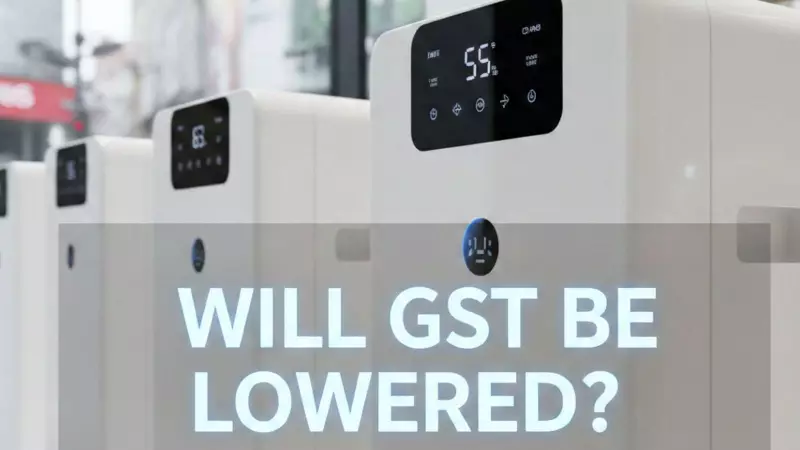
The Delhi High Court has issued a significant directive, urging the Goods and Services Tax (GST) Council to convene an urgent meeting to deliberate on reducing or abolishing the GST levied on air purifiers. This move comes in response to the dire air quality situation plaguing the national capital and its surrounding regions.
Court Questions 18% GST, Suggests 5% Rate Alignment
A bench led by Chief Justice Devendra Kumar Upadhyaya and Justice Tushar Rao Gedela observed that there appears to be no justifiable reason for not applying a 5% GST rate to air purifiers. The court pointed to a February 2020 notification that lists certain devices, including medical equipment, attracting a 5% tax. Given the functional role of air purifiers in ensuring clean air, the bench prima facie found them eligible for the same concessional rate.
The court was hearing a Public Interest Litigation (PIL) filed by advocates Kapil Madan and Gurmukh Singh Arora. The plea challenged the current 18% GST slab on air purifiers, arguing they should be classified as medical devices, which are taxed at 5%. The petitioners emphasized the critical need for these devices due to the worsening air pollution in Delhi-NCR.

"21,000 Breaths a Day": Bench Highlights Health Emergency
During the hearing on December 24, 2025, the judges made a powerful observation on the public health crisis. The bench noted, "We all breathe. You know how many times we breathe in a day, at least 21,000 times a day. Just calculate the harm you are doing to your lungs just by breathing 21,000 times a day, and that’s involuntary." This stark statement underscored the court's concern over the involuntary exposure of citizens to toxic air.
The court also took note of a report by the Parliamentary Standing Committee on Climate Change, which had previously recommended that the government either abolish or lower the GST on air purifiers. This added weight to the petitioners' arguments.
GST Council Directed for Earliest Possible Meeting
While the counsel for the Union Government submitted that GST rate decisions are policy matters for the GST Council, the court proceeded to issue a directive. It ordered that the issue of lowering GST on air purifiers be placed before the Council for a decision "at the earliest."
Acknowledging that the GST Council is a pan-India body whose meetings require coordination, the bench remained firm on the urgency. It stated, "However, taking into consideration the air quality situation in Delhi and nearby areas, it will be appropriate to require the GST council to meet at the earliest." The court suggested the meeting could be held via video conferencing if a physical gathering was not feasible.
The matter has been adjourned, and the court expects the Council to deliberate and return with a decision. This judicial push marks a crucial intervention that could make air purifiers more affordable for millions of residents struggling with hazardous air pollution levels.