

DNA Test Solves Heartbreaking Railway Victim Identity Mystery in Mumbai
In October 2024, a poignant scene unfolded at a Government Railway Police (GRP) chowky in Kurla station, Mumbai. Mangibai Naik, a 53-year-old woman from Ghatkopar, arrived to examine a photograph of an unidentified young man who had died in a railway accident. After sharing the image with her daughter via phone, Naik became convinced the deceased was her missing son, Nandesh.
A Second Claim Emerges, Creating a Tragic Dilemma
The identification seemed definitive until Bholanath Barik, a security guard from Boisar, appeared at the chowky days later. Barik firmly believed the face in the photograph belonged to his own missing son, Ghanshyam. Both families had conducted exhaustive searches for their sons, with no prior leads. A GRP officer explained the complexity: "The man had died in a railway accident four months earlier and was cremated. He carried no personal effects for recognition."
Fortunately, investigators had preserved a blood sample. They turned to the state forensic science laboratory for a conclusive DNA profile to resolve this painful conflict. When the results arrived, they delivered devastating news to Barik: the victim was indeed his son, Ghanshyam.

The Stark Reality of Unidentified Railway Fatalities
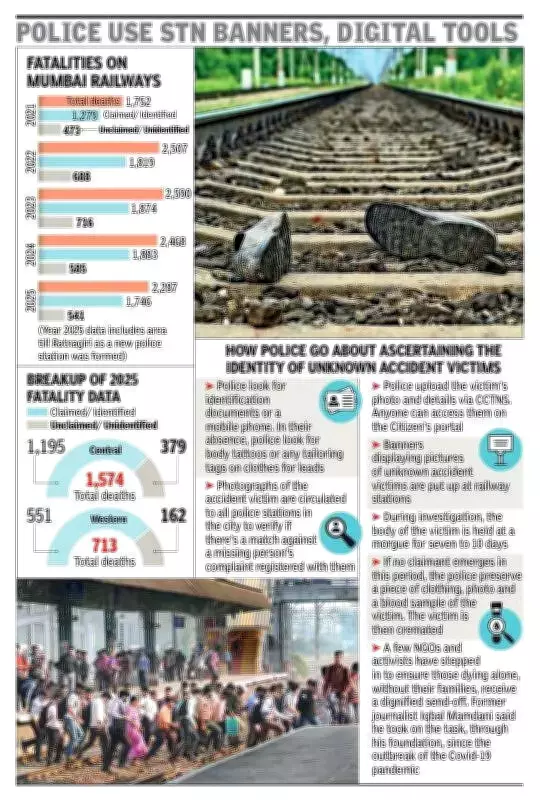
This case highlights a grim national statistic. In 2025 alone, railway accidents claimed 2,287 lives across India. Fatalities resulted from track crossing, falls from overcrowded trains, collisions with railway poles, and other factors. Alarmingly, over 23% of these victims remained unidentified, leaving families in perpetual uncertainty about their loved ones' fates.
The GRP has intensified efforts to identify unknown victims. Towards the end of last year, a special campaign established dedicated four-member teams at each chowky to pursue every possible lead. However, significant challenges persist. Victims are sometimes found disfigured beyond recognition or without identification documents or cellphones that could provide crucial clues.
Ghanshyam's Story: From Anonymous Statistic to Identified Victim
Ghanshyam, who worked as a guard alongside his father, wasn't carrying any ID when he was struck by a train between Kurla and Vidyavihar stations on June 8, 2024, while crossing the tracks. Police officials noted frequent father-son conflicts over money. Ghanshyam left Boisar on June 6 and never returned.
He might have remained an anonymous statistic if not for a friend who spotted his photo on a police banner at Kurla railway station and alerted his father. These banners are strategically placed so passing commuters might recognize someone they know.
Systemic Challenges and Digital Solutions
Activist Sameer Zaveri pointed out that families of victims often lack clarity on which authority to approach for help. "Migrant workers perishing in railway accidents in the city may remain unidentified as their families, living thousands of kilometers away, may not even be aware an accident occurred," Zaveri stated.
Standard procedure dictates that when a victim's identity is unknown, the body is held in a morgue for seven to ten days during police investigation. If no claimant emerges, the victim is cremated. Police retain a photo, a piece of clothing, and personal belongings in case the family is traced later. Investigators have sometimes successfully identified victims through body tattoos or tailoring tags on clothes.
The CCTNS (Crime and Criminal Tracking Network and Systems) and the Maharashtra Citizen's portal have become vital tools. Police input details and upload photos of unidentified deceased persons via CCTNS, a government project digitizing crime data and linking police stations nationwide. These details are accessible to anyone using the portal, a digital platform for tracking complaints and reporting incidents to police, featuring search options by date and location.
A Success Story: Gopinath's Identification Through Digital Means
On September 23, 2025, a male commuter in his mid-thirties died after falling from a long-distance train between Sion and Kurla stations. With no identification found, police uploaded his details and photo into CCTNS. Odisha's Binati Durva eventually saw these details on the portal while searching for her 36-year-old brother, Gopinath.

Gopinath had traveled from Odisha to Madgaon, Goa, with friends to seek work but decided to return after a day. He called his wife to say he would take a train to Mumbai and then another to Odisha but was never heard from again. "We wondered if he had changed his mind or if his phone was stolen. Even his friends were clueless," Binati recounted.
Odisha police informed the Durva family that a complaint couldn't be registered as Gopinath went missing in another state. An acquaintance within the police department directed them to the Citizen's portal, where they spotted a photo resembling Gopinath. Distant relatives in Mumbai verified details with the GRP. "We were shocked to learn Gopinath had fallen off a train and perished," Binati said.
She and her brother-in-law traveled to Mumbai on unreserved train tickets, carrying a police note for the ticket checker explaining their situation. With limited funds, they stayed overnight at a temple before claiming Gopinath's body, a testament to the emotional and financial toll on families navigating this tragic process.





