Ernakulam Police Seize 177kg of Ganja in Major Drug Crackdown
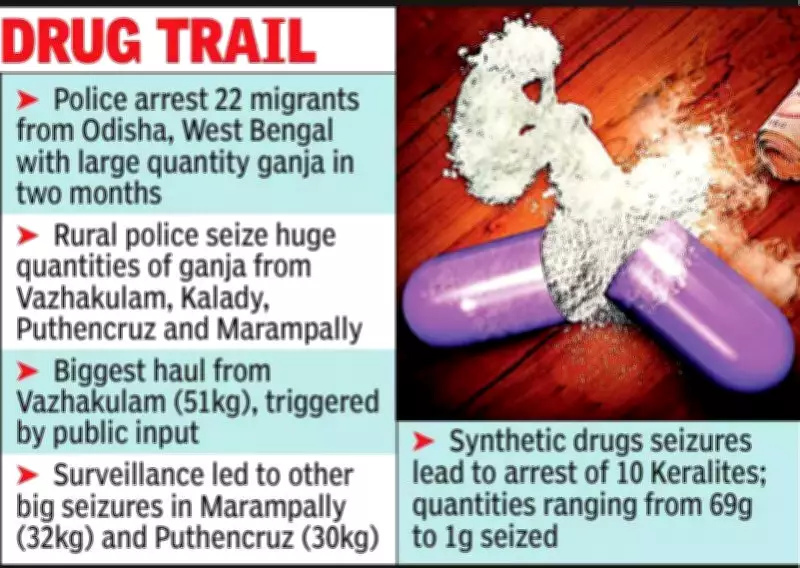
In a significant development, the Ernakulam rural police have seized approximately 177 kilograms of ganja within the first two months of 2025. This substantial haul represents nearly one-third of the total quantity of ganja confiscated throughout the entire year, which stands at 603 kilograms. The bulk of the seized narcotics was trafficked from states such as Odisha and West Bengal, utilizing trains for long-distance transport before being distributed locally via autorickshaws to avoid detection.
Migrant Workers Arrested in Connection with Drug Trafficking
So far, twenty-two migrants, who posed as migrant workers, have been arrested in connection with these large-scale ganja seizures. All the accused individuals hail from either West Bengal or Odisha, highlighting a pattern in the origins of the traffickers. The police have noted that in all major ganja seizures, the perpetrators were migrants from these regions, underscoring a specific demographic involved in the illicit trade.
Law-and-Order Crisis and Formation of Vigilance Committee
In early February, a surge in drug peddling, including ganja, heroin, and MDMA, escalated into a law-and-order crisis in rural Ernakulam. Incidents of vigilantism by locals against the drug menace led to attacks on innocent migrant workers. Although the vigilantes were subsequently arrested, police acknowledged the existence of a significant drug problem in the area. In response, a vigilance committee was established to tackle the issue, comprising representatives from migrant workers, the public, and led by police officers.

Public Input Leads to Major Seizure
Nearly two weeks after the formation of the committee, police made the largest ganja seizure of the year. A senior officer revealed that public input was instrumental in this case, leading to the confiscation of 51 kilograms of ganja from a house in Vazhakulam. This success underscores the importance of community involvement in combating drug trafficking.
Enhanced Surveillance and Intelligence Gathering
Police have augmented surveillance and intelligence gathering efforts to collect more details on drug peddling activities. Additional officers have been assigned exclusive duties to address the menace. Heightened vigilance has resulted in the seizure of 83 kilograms of ganja over the past two weeks and the arrest of 12 accused individuals, according to an officer.
Police Efforts and Public Cooperation
Perumbavoor assistant superintendent of police Hardik Meena emphasized the role of police efforts, stating, "Apart from one case where we received public input, all the other cases were the result of hard work of the Dansaf team, who are conducting intensive surveillance. At the same time, whenever people see something illegal, they should call police and inform."
Incidents of Vigilantism and Police Response
The intensive police action followed incidents in Kandanthara, a region densely populated by migrant workers, where K A Shareef, husband of Vengola panchayat president, and a group of residents assaulted migrant workers, accusing them of selling drugs. Perumbavoor police found no evidence against the assaulted migrants and, based on CCTV footage, arrested and remanded Shareef for the attack. The vigilance committee was formed in the aftermath of this unrest.
Improved Monitoring and Community Alertness
Police have since permanently stationed a control room vehicle in the region for constant monitoring. Vengola panchayat vice-president V H Mohammed reported an improvement in the situation, noting, "Frequent visits of suspicious outsiders to the region have come down. However, locals continue to be on high alert. Police action has also strengthened. Apart from police making seizures, locals too are alerting police about drug use."

Struggle with Synthetic Drugs
Meanwhile, the district continues to grapple with the menace of synthetic drugs. Over the past two months, rural police arrested 10 men in possession of MDMA. While those apprehended with bulk quantities of ganja were predominantly migrant workers, suspects in all 10 synthetic drug cases were locals hailing from either Ernakulam or neighboring districts, indicating a different demographic involved in synthetic drug trafficking.