Former CJI Gavai Highlights Justice Vishwanathan's Key Role in Bulldozer Judgment
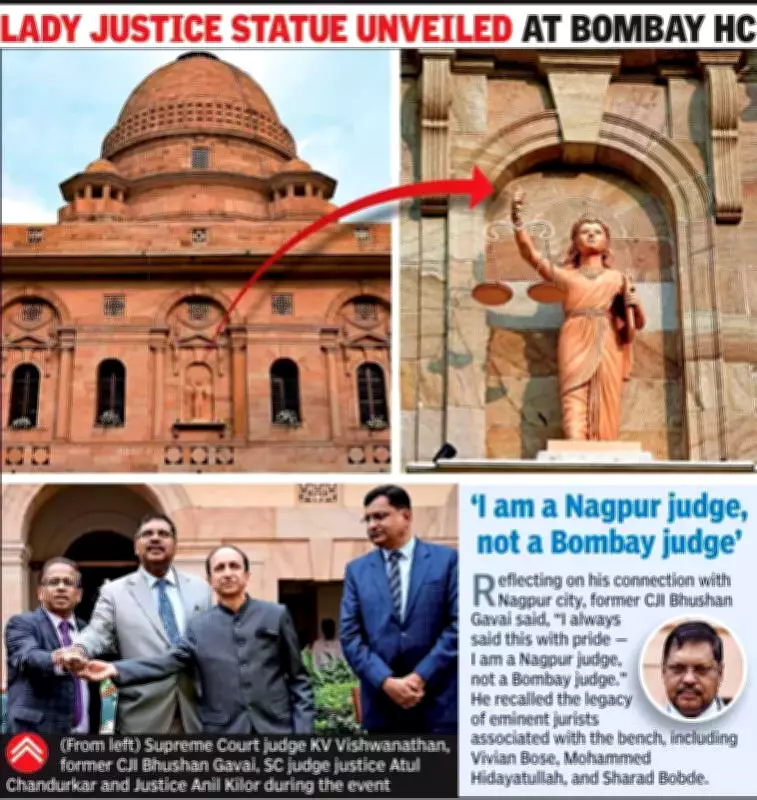
Former Chief Justice of India Bhushan Gavai made significant remarks on Saturday regarding the widely-discussed "bulldozer" judgment, highlighting the crucial contribution of Supreme Court Judge KV Vishwanathan. Speaking at the unveiling ceremony of the Lady Justice statue at the Nagpur bench of Bombay High Court, Gavai revealed that Vishwanathan's role in shaping the landmark ruling was "equal, if not greater" than that of the decision's primary author.
Ceremony Marks Historic Moment for Nagpur Judiciary
The event brought together numerous distinguished legal personalities, including several sitting and former judges, senior members of the Bar, court officials, and office-bearers of the High Court Bar Association Nagpur. Justice Vishwanathan himself had the honor of formally unveiling the statue, marking a significant moment in the court's history.
Gavai reflected on the judicial association he shared with Vishwanathan during their time together on the Supreme Court bench. "The bulldozer-related judgment is especially close to our hearts," Gavai stated, emphasizing the collaborative nature of judicial decision-making that often goes unrecognized in public discourse.
Justice Vishwanathan's Emotional Connection to Nagpur
Justice KV Vishwanathan, who is scheduled to become the 58th Chief Justice of India in August 2030, described the unveiling as a profound privilege. He recalled his early association with the iconic High Court building, sharing a personal anecdote that highlighted his long-standing connection to the institution.
"I remember once standing outside this very building and clicking a photograph," Vishwanathan reminisced. "Little did I know then that one day I would return to unveil such a significant memorial."
Reflecting on the deeper meaning behind the statue, Vishwanathan emphasized its symbolic importance. "It is a symbol of justice, but also of inclusion. It represents equality and fraternity, embodying what this institution stands for," he explained, connecting the physical monument to constitutional values.
Architectural Grandeur and Judicial Responsibility
Justice Vishwanathan also praised the architectural magnificence of the High Court building, constructed in 1940. "The structure itself is majestic. It inspires anyone who enters to maintain decorum and dignity and instills a deep sense of responsibility," he observed.
He added that the newly installed statue would serve as an enduring reminder of fairness and constitutional morality for all who visit the court premises.
Filling a Long-Standing Void
Supreme Court Judge Justice Atul Chandurkar noted that the installation addressed a noticeable gap in the court's environment. "I always felt that this particular spot was vacant, and now that Lady Justice resides here, it feels truly complete," he remarked.
Chandurkar emphasized that the High Court building, with its rich history dating back to 1940, had gained a meaningful addition with this sculpture presented in its Indian form.
Reaffirmation of Judicial Values
Justice Anil Kilor, administrative judge of the Nagpur Bench, described the ceremony as more than just a statue installation. "It is not merely the installation of a statue but a reaffirmation of the timeless values of fairness, courage and integrity that define the judiciary," he stated.
Kilor added, "The monument should remind us that justice must always remain fair, accessible and transparent," highlighting the ongoing responsibility of the judicial system to uphold these principles.
Gavai's Pride in Nagpur Connection
Former Chief Justice Bhushan Gavai expressed his strong identification with Nagpur during the ceremony. "I always said this with pride — I am a Nagpur judge, not a Bombay judge," he declared, emphasizing his regional connection.
Gavai recalled the distinguished legacy of eminent jurists associated with the Nagpur bench, including Vivian Bose, Mohammed Hidayatullah, and Sharad Bobde, placing the current ceremony within this rich historical context of judicial excellence.
The event served as both a celebration of judicial heritage and an important revelation about the collaborative nature of landmark Supreme Court decisions, particularly highlighting Justice Vishwanathan's substantial contribution to the significant bulldozer judgment that has captured national attention.