

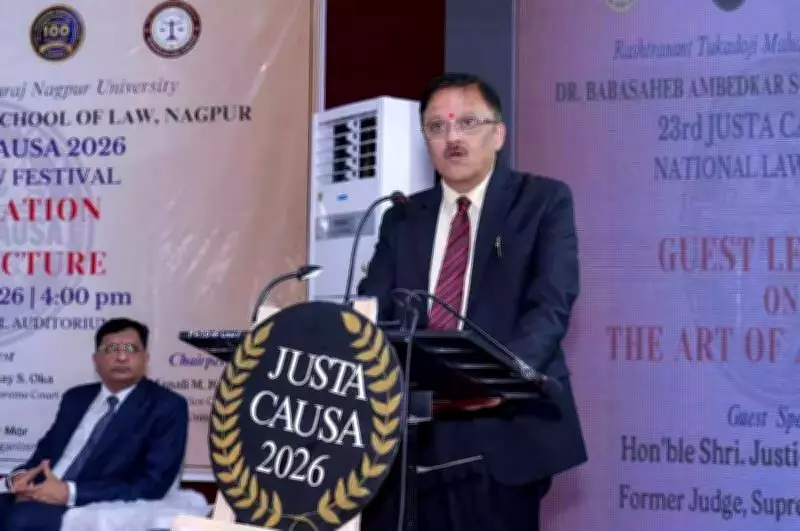
Former Supreme Court Justice Stresses Human Element in Legal Profession
In a powerful address at the National Justa Causa Law Festival and the centenary event of Nagpur University's Dr Ambedkar Law College, former Supreme Court judge Justice Abhay Oka delivered a compelling message to aspiring lawyers. He asserted that the future of legal advocacy depends not on artificial intelligence or simulated environments, but on the tangible experiences of trial courts and the nuanced application of human judgment.
Trial Courts: The Foundation of Justice
Justice Oka directly challenged what he termed a 'misplaced perception' that trial courts are inferior within the judicial hierarchy. "Trial and district courts are constitutional courts," he declared emphatically. "They are the courts of the common man and the most important pillar of the justice system." He elaborated that these courts form the essential bedrock of India's judicial structure, where the majority of citizens first encounter the legal process.
Limitations of Simulations and Technology
Oka's remarks arrive at a critical juncture as legal education worldwide increasingly incorporates technology and simulation-based learning methods. While acknowledging the utility of moot court competitions, he cautioned that they often foster "an artificial sense of preparedness." "Advocacy is an art that can only be learnt through practice in actual courts," he advised, urging students to immerse themselves in courtroom proceedings and seek mentorship under seasoned practitioners.

On the role of artificial intelligence, Justice Oka delineated a clear boundary. "AI can help draft petitions or assist in legal research, but ultimately it is the application of the human mind that identifies new legal angles and doctrines," he stated. He cited landmark constitutional developments like the basic structure doctrine as examples of human insight that algorithmic processes could not have conceived. "AI may assist in drafting, but it cannot understand human behaviour or the complexities of individual cases," he added.
The Art and Ethics of Advocacy
Justice Oka underscored the ethical foundation of the legal profession, reminding attendees that "a lawyer is first an officer of the court." The primary duty, he explained, is to assist the judiciary in reaching legally sound conclusions. He emphasized that effective advocacy requires a deep understanding of human psychology—interpreting judges, clients, witnesses, and opposing counsel.
"Every case has its own nuances. Standard arguments are not enough," he noted, advising lawyers to exercise thoughtful deliberation. "Sometimes silence is the best advocacy."
Broader Democratic Concerns
Placing his observations in a wider democratic context, Justice Oka highlighted a concerning decline in legally trained legislators. He pointed out that nearly 36% of members in India's inaugural Parliament were lawyers, compared to approximately 4% today. This shift, he suggested, could potentially diminish institutional depth and legal acumen in governance and policy-making.
Support from the Judiciary
Echoing Justice Oka's perspectives, Justice Anil Kilor, the administrative judge at the Nagpur bench of the Bombay High Court, concurred that moot courts can provide students with "a false sense of competence." He stressed that genuine legal skills are cultivated through direct courtroom exposure and meaningful client interactions.
The significant event was attended by notable figures including Nagpur University Vice-Chancellor Manali Kshirsagar, former Supreme Court judge Justice Vikas Sirpurkar, and various legal academics, underscoring the importance of the discourse on the future of legal education and practice.






