Goa Revenue Minister Babush Monserrate Acquitted in 2016 Rape Case
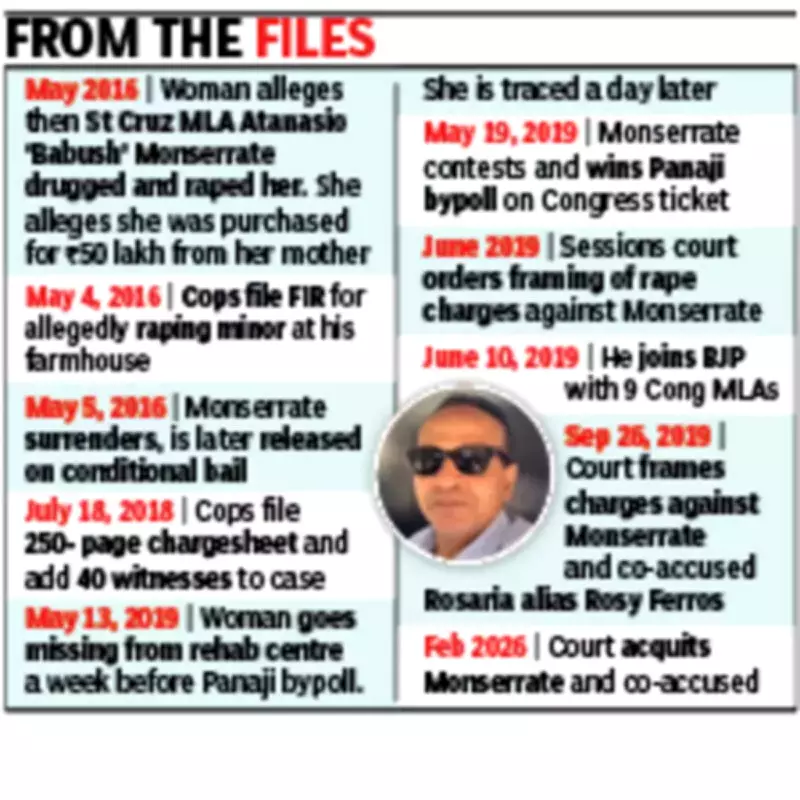
In a significant legal development, a special court in Panaji on Wednesday acquitted Goa Revenue Minister and Panaji MLA Atanasio 'Babush' Monserrate of rape charges in a high-profile 2016 case. The court ruled that the prosecution failed to prove two critical elements: that sexual intercourse occurred and that the woman was a minor at the time of the alleged incident.
Prosecution's Case Collapses Under Scrutiny
Sessions Judge Irshad Agha delivered the verdict, stating, "The prosecution in the present case failed to prove that accused Atanasio Monserrate had sexual intercourse with her and that her age was below 16 years. The prosecution failed to prove her age. In view of the evidence and case laws, the benefit of two years minus and plus came in favour of Monserrate." This legal principle allowed for reasonable doubt regarding the woman's age, ultimately leading to the acquittal.
The woman had initially alleged that her mother sold her to Monserrate, who was then the Santa Cruz MLA, for Rs 50 lakh. However, during the trial, she admitted that she had fabricated the allegations. The court noted that her complaint to police and magistrates about being sold through a broker was false, with the prosecution's case collapsing when she confirmed this under cross-examination.

Co-Accused Also Cleared of Charges
The court also acquitted co-accused Rosy Ferros, a resident of Caranzalem whom the woman referred to as "aunty." Ferros was alleged to have brokered the deal to sell the woman to Monserrate. The acquittal extended to her as the foundational claims of the case were deemed unsubstantiated.
This case marked a historic moment as Monserrate became the first sitting MLA in Goa to face charges under the stringent Protection of Children from Sexual Offences (Pocso) Act. However, the court held that the prosecution could not establish the woman's age at the time of the offence, granting Monserrate the benefit of the doubt.
Court Highlights Flaws in Testimony
The court emphasized that the most vital fact requiring proof was the woman's age when the offence was committed. It observed that her testimony revealed inconsistencies and external influences. She stated that an NGO advised her to continue making incriminating statements against Monserrate and Rosy to avoid being perceived as a liar after news reports emerged.
Additionally, the woman admitted that her anger towards Rosy for taking her phone and stopping financial assistance may have motivated the complaint. The court remarked, "This shows that a complaint must have been lodged in anger." She also acknowledged that Monserrate had provided financial help due to her family situation but stopped, leading to frustration and depression that fueled her allegations.
Regarding the specific accusations, the woman retracted claims of any untoward incidents at a farmhouse. The prosecution's case had alleged that Monserrate and Rosy enticed her with expensive gifts, induced her to send lewd photographs, used them to threaten her, and forced her to meet Monserrate at his house. These claims were ultimately dismissed by the court due to lack of corroborative evidence and the woman's admissions of fabrication.
The acquittal concludes a lengthy legal battle that has drawn public attention in Goa, with the court's decision hinging on the prosecution's inability to meet the burden of proof required under the law.