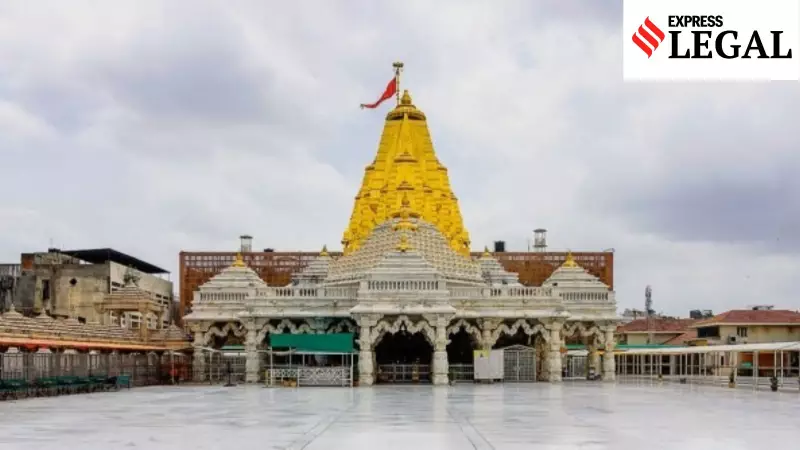
In a landmark verdict that concludes a legal battle spanning over seven decades, the Gujarat High Court has definitively ruled that the revered Arasuri Ambaji Temple is a public religious institution. The court dismissed all claims of ownership and special hereditary privileges by the heirs of the erstwhile Danta royal family.
A Seven-Decade Legal Battle Comes to an End
Justice Hemant M. Prachchhak delivered the decisive judgment, hearing a plea filed by the royal heirs against a 2008 district court order. That earlier order had rejected their application contesting the temple's registration as a public trust and their claimed special rights. The High Court has now firmly upheld that lower court's decision.
The core of the dispute revolved around whether the temple and its properties were the private assets of the former rulers of Danta state. The petitioners argued that Goddess Amba Bhavani was their Kuldevi (family deity), claiming their ancestors consecrated and built the temple in the year 1136. They maintained that the shrine was distinct from state properties and remained their private possession even after India's independence and the merger of princely states.

Court Rejects Hereditary Privileges as "Illegal and Unreasonable"
Beyond ownership, the royal family sought to retain specific ceremonial privileges. These included the exclusive right to offer puja on the 8th day of Navratri, perform a havan in the temple, wave the chamar (a sacred whisk) before the deity, and to have the temple cleared of other pilgrims during these rituals.
Justice Prachchhak unequivocally rejected these claims. The court stated that granting such special hereditary privileges was "completely illegal, erroneous, and unreasonable." It emphasized that the temple is a public institution, and such exclusive rights contravene its fundamental nature.
Supreme Court Precedent and the Merger Agreement
The High Court's ruling heavily relied on a pivotal 1957 Supreme Court judgment on the same matter. The apex court had then held that once property is bequeathed to a deity, it becomes the deity's property, and the heirs of the former ruler cannot claim rights over it. The Supreme Court had also noted that the Maharana failed to establish legal title to the temple.
Furthermore, the judgment addressed the Merger Agreement of October 5, 1948. The court cited Article 363 of the Constitution, which bars judicial interference in disputes arising from such treaties and agreements. It pointed out that a separate machinery was provided for these disputes, making the royal family's claim of private ownership legally untenable.
"It is pertinent to note that to date, the heirs of the erstwhile Danta State have not succeeded in any Court of law concerning the fact that the disputed property... is private property," the court observed. It crystalized the verdict by stating that the Arasuri Ambaji Temple is unequivocally a public temple.
Verdict Upholds Public Trust Status
The final order has two key outcomes. First, it dismisses the royal family's plea against the temple's registration under the Gujarat (Bombay) Public Trust Act. Second, it bars them from performing any special puja on the 8th day of Ashwin Maas Navratri unless they can first establish a legal right over the property—a hurdle they have failed to clear for generations.
This ruling, stemming from a 2009 legal challenge under the Bombay Public Trust Act, finally draws a line under a conflict that began in 1953. It reinforces the principle that historic places of worship, especially those of great public devotion like the Ambaji Temple, are assets held in trust for the community, not private fiefdoms.