

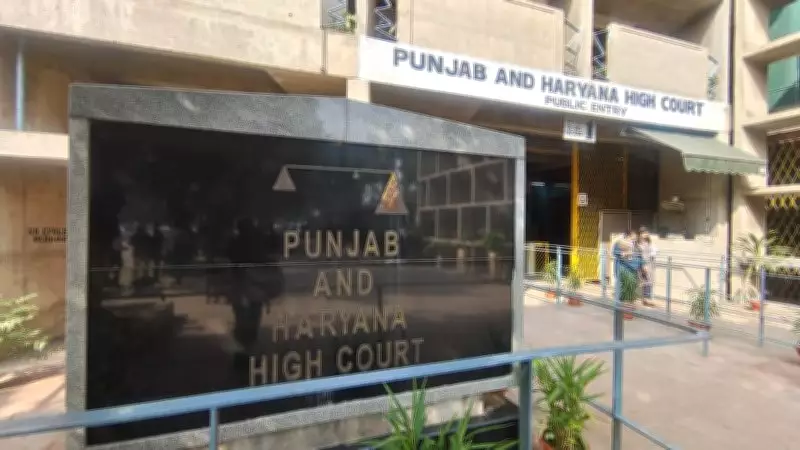
Punjab and Haryana High Court Intervenes to Protect Green Belt in Tricity Region
The Punjab and Haryana High Court has taken a decisive step by issuing notices to the Union of India, the National Highway Authority of India (NHAI), and the Ministry of Environment, Forest and Climate Change. This action comes in response to a public interest petition that seeks immediate judicial intervention to stop the cutting of trees for the Tricity Ring Road project. The bench, comprising Chief Justice Sheel Nagu and Justice Sanjiv Berry, has also issued a notice of motion regarding a stay, with the matter scheduled for further hearing on April 1.
Petition Challenges Forest Clearances for Highway Project
Filed by 21 individuals through senior advocate Anand Chhibbar, the petition challenges the forest clearances granted for a major highway project that threatens the Tricity's last surviving green belt. The petitioners have requested directions to halt tree felling immediately and to quash the "Stage-I" forest clearance dated July 31, 2025, and "Stage-II" clearance dated January 8, 2026. These approvals permit the diversion of 17.57 hectares (43.416 acres) of forest land.
The core of the petition focuses on the proposed 6-lane Zirakpur bypass or access-controlled spur connectivity project, which is part of the Tricity Ring Road undertaken by NHAI. Spanning approximately 19.2 km, this project would cut through ecologically fragile zones, including:

- Punjab forest patches
- The Ghaggar riverine belt
- Dense scrub forests in Panchkula
- Sector-1A green belt
- Panchkula Golf Course
Ecological Damage and Tree Felling Concerns
The plea highlights that over 5,000 mature trees, many aged between 20 to 30 years, are slated to be felled. This includes:
- Over 2,000 trees from notified forest land in Punjab
- More than 2,200 trees from Panchkula Golf Course
- Around 1,000 trees from Sector-1A and adjoining green belts
Questioning the project design, the petition argues that the "partially elevated" corridor is illusory. With a proposed height of 5.5-6 metres, it is significantly lower than the height of mature trees (8-15 metres), making large-scale felling inevitable even in elevated stretches.
Impact on Urban Ecology and Constitutional Violations
The alignment is said to slice through one of the last continuous green lungs of the Tricity region. Panchkula Golf Course, spread across about 124 acres and housing nearly 14,000 trees, is described as a principal urban ecological asset. The proposed alignment would cut across five fairways, rendering the course dysfunctional and impacting more than 2,500 members.
Raising constitutional concerns, the petition asserts that the clearances violate the mandate under Articles 21, 48A, and 51A(g) of the Indian Constitution. It stresses that the right to life includes the right to a "clean, healthy, and pollution-free environment." The plea invokes established environmental jurisprudence, stating that the project runs contrary to principles such as the precautionary principle, sustainable development, public trust doctrine, and intergenerational equity.
Compensatory Afforestation and Broader Environmental Context
The petition terms the compensatory afforestation proposed in Ferozepur, over 240 km away, as illusory. It asserts that mature ecosystems cannot be replaced by saplings, warning that "mature trees cannot be substituted by saplings which take decades to attain ecological equivalence and often suffer high mortality."
Placing the issue in a broader environmental context, the plea points out that Punjab and Haryana have forest and tree cover of just 3.67% and 3.65%, respectively. These figures are far below the national average of 21.71% and the 33% benchmark under the National Forest Policy. The petition terms further diversion of forest land as "ecological regression of alarming magnitude."

Proposed Alternatives and Future Implications
The petition also proposes alternative alignments, such as rerouting the project to connect with existing highways or along the Ghaggar riverbed. These options are argued to preserve critical green zones without compromising connectivity. The High Court's intervention underscores the growing tension between infrastructure development and environmental conservation in India, setting a precedent for future projects that may impact ecological balance.





