The Plight of Domestic Workers in India: A Legal Vacuum
In 2007, Tamil Nadu emerged as a pioneer by establishing one of the first welfare boards for domestic workers under a 1982 enactment designed to regulate the employment and working conditions of manual laborers in the state. This initiative set a precedent, with Maharashtra enacting a similar law in 2008. Despite these state-level efforts, domestic workers across India continue to face significant legal gaps in protection.
Supreme Court Observations and State Initiatives
In 2025, the Supreme Court acknowledged the proactive measures taken by several states to safeguard the rights and welfare of domestic workers, even in the absence of comprehensive central legislation. The Court highlighted that the Tamil Nadu Domestic Workers Welfare Board administers various social security benefits, including education assistance, marriage assistance, delivery assistance, accidental death compensation, and pensions. These benefits are provided through fixed monetary compensation rates.
However, a stark reality persists: Tamil Nadu currently has approximately 18 lakh domestic workers, yet only a small fraction are registered with the welfare board. This low registration rate is primarily due to a lack of awareness and motivation among workers, compounded by historical neglect from lawmakers who traditionally focused on industrial workers, excluding domestic workers from labor legislation.

Legal Exclusions and Historical Context
The Minimum Wages Act of 1948 empowers governments to set minimum wages for scheduled employments, but domestic workers have never been included in this schedule. Section 27 of the Act, which covers agricultural employment, was never extended to domestic workers, leaving their wages subject to the whims of employers.
Internationally, the International Labour Organization (ILO) Convention No. 189, adopted in 2011, defines domestic work as performed in or for households and recognizes domestic workers as individuals engaged in such work within an employment relationship. This classification underscores that domestic work involves an exchange of services for remuneration, qualifying it as productive employment.
Judicial Interpretations and Legislative Hurdles
In 1978, a seven-judge bench led by Justice V.R. Krishna Iyer expanded the definition of 'industry' under the Industrial Disputes Act of 1947 to include systematic activities involving cooperation between employers and workers for production or services. This raised hopes that domestic workers might be covered under this broader definition.
However, Parliament amended the Industrial Disputes Act in 1982 to explicitly exclude 'domestic service,' though this amendment was never enforced. The matter was referred to a larger nine-judge bench, where it remains pending. Subsequently, the Industrial Relations Code of 2020, which subsumed the Industrial Disputes Act, specifically excludes domestic service from the definition of industry under Section 2(p). This Code was brought into force on November 21, 2025, after a five-year delay.
Despite this exclusion, the Code includes provisions from the Unorganized Workers Social Security Act of 2008, applying trade union rights to unorganized workers, a category that encompasses domestic workers. Additionally, the Code on Social Security of 2020 empowers the central government to constitute a National Social Security Board for unorganized workers.
Failed Legislative Attempts and Advocacy Efforts
Numerous attempts to enact specific legal protections for domestic workers have failed over the decades. Bills proposed in 1959, 1989, 2004, 2008, 2015, 2016, and 2017, often pushed by private initiatives and bodies like the National Commission for Women, did not pass. While laws such as the Juvenile Justice Acts and the Vishaka judgment addressed child labor and sexual harassment, they did not specifically reference domestic workers.

In 2019, the National Human Rights Commission recommended that the Union government adopt national legislation for domestic workers in line with ILO Convention No. 189. The Shramjeevi Mahila Samiti, an NGO, petitioned the Supreme Court, leading to directives for the Ministry of Labour and Employment to finalize a registration module for unorganized workers by the end of 2018, with states instructed to register workers progressively.
Supreme Court Interventions and Recent Developments
In a criminal case involving allegations against a domestic worker, the Supreme Court, led by Justice Surya Kant, invoked the doctrine of parens patriae to address broader welfare issues. The Court noted its duty to intervene in the absence of specific protections but refrained from laying down an interim legal code, emphasizing respect for the separation of powers.
Following the notification of the Industrial Relations Code, which excludes domestic services except for trade union rights, a group of women workers from Tamil Nadu (Penn Thozhilalargal Sangam) petitioned the Supreme Court to declare that domestic workers are entitled to minimum wages and protection under Articles 21 and 23 of the Constitution. They also sought the fixation of minimum wages.
To the shock of many, Chief Justice Surya Kant, who had authored the earlier order, expressed concerns that fixing minimum wages for domestic workers could lead to friction and litigation. He highlighted the role of state governments, expressing hope that competent authorities in each state would develop suitable mechanisms to improve conditions and prevent exploitation, particularly regarding minimum wages. The writ petition was disposed of in January with directions to states to address grievances raised by workers' associations.
Current Status and Future Uncertainties
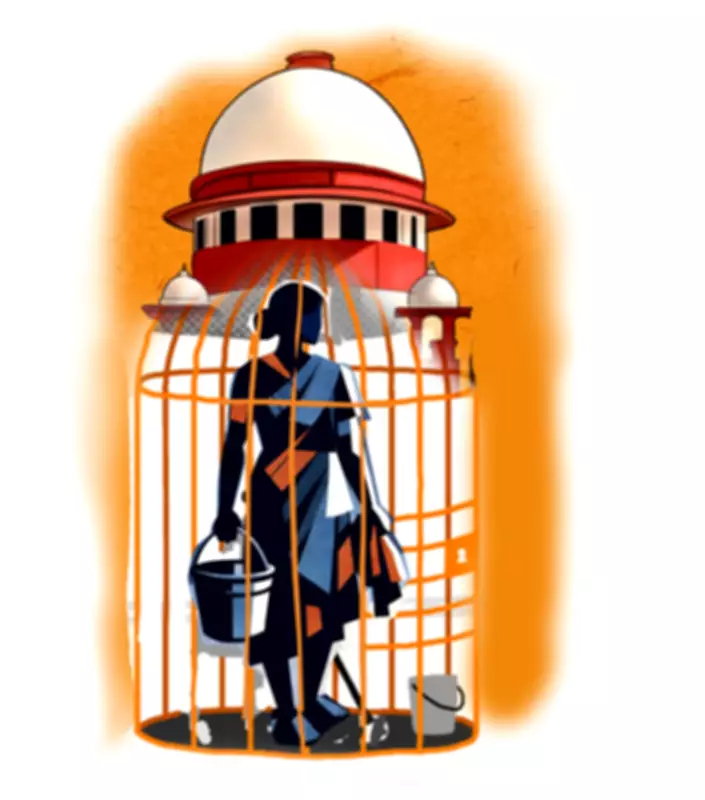
As a result, domestic workers are largely reliant on state government initiatives, lacking uniform protection under central law. While the Code on Social Security covers unorganized workers, including gig and platform workers excluded from the Industrial Relations Code, the fate of existing state welfare boards remains uncertain.
When the four new labour codes were notified, Prime Minister Narendra Modi expressed pride in the nation's workforce, invoking the slogan "Shramev Jayate" and touting the reforms as a step towards Atmanirbhar Bharat. Yet, domestic workers continue to bear the brunt of inadequate legal safeguards, highlighting the ongoing struggle for their rights and welfare in India.