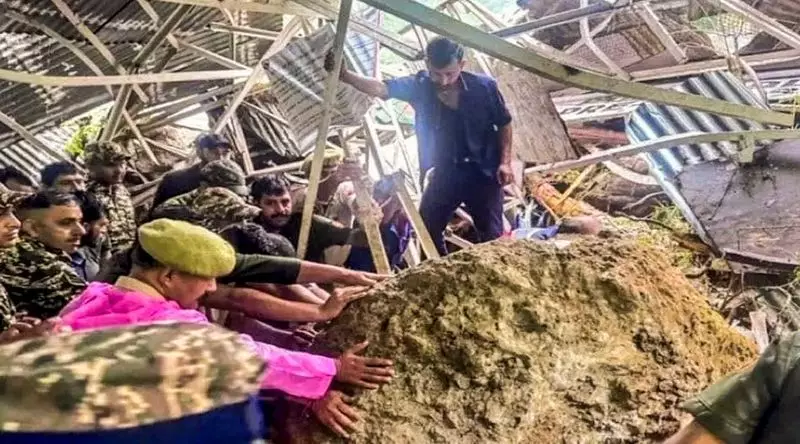
The Jammu & Kashmir and Ladakh High Court has dismissed a Public Interest Litigation (PIL) that sought action against the Shri Mata Vaishno Devi Shrine Board (SMVDSB) for a devastating landslide in 2022. The tragic incident, which occurred near the holy shrine in Katra, resulted in the deaths of twelve pilgrims.
Court Rules Landslide a Natural Calamity
A division bench comprising Chief Justice N. Kotiswar Singh and Justice Moksha Khajuria Kazmi delivered the significant verdict. The judges concluded that the landslide was a natural disaster triggered by unprecedented heavy rainfall, and not a consequence of negligence by the shrine board's management.
The PIL, filed by an organization called 'Voice for Rights,' had alleged that the landslide and the resulting fatalities were due to the illegal construction of a retaining wall by the SMVDSB. The petitioners argued that this construction destabilized the hill slope, leading to the catastrophe on July 8, 2022.

Shrine Board's Defense and Technical Reports
In its defense, the Vaishno Devi Board presented detailed technical and geological reports. These reports were prepared by expert agencies following the incident. The findings consistently pointed to extreme weather conditions as the primary cause.
The court noted that the area had experienced exceptionally heavy rainfall measuring 169 mm in just four hours on that fateful day. This intense downpour led to waterlogging and the subsequent slope failure. The bench emphasized that the board had taken necessary precautions and that the site was not traditionally considered a high-risk landslide zone prior to this extreme weather event.
The retaining wall in question was built in 2005-06, and no such incident had occurred in the intervening 16 years, further supporting the board's stance that the wall was not the causative factor.
Legal Scrutiny and Final Verdict
The High Court meticulously examined the evidence, including the expert reports and the sequence of events. It found no substantial material to support the allegations of negligence or illegal activity on the part of the shrine board. The judges stated that the board had acted responsibly in the aftermath, providing compensation and aid to the victims' families.
In its final order, the court quashed the PIL, relieving the Shri Mata Vaishno Devi Shrine Board of any blame for the tragic incident. The ruling underscores the legal principle that authorities cannot be held liable for damages caused solely by acts of nature, provided due diligence was observed.
This verdict brings legal closure to a painful chapter for the shrine board and the families affected by the landslide, officially attributing the tragedy to a force majeure natural event.