

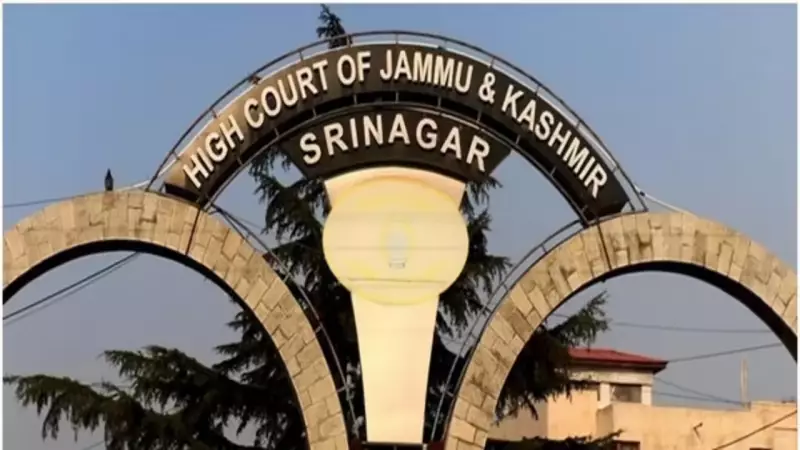
Jammu and Kashmir High Court Upholds PSA Detention in Security Case
The Jammu and Kashmir High Court has maintained the detention of a woman under the Public Safety Act, rejecting her challenge against the government's order that accused her of having connections with the family of a key figure in the 2008 Mumbai attacks.
Court's Verdict on Detention Challenge
On Thursday, a division bench comprising Chief Justice Arun Palli and Justice Rajnesh Oswal dismissed the writ petition filed by appellant Shaista Maqbool, who had contested her detention under the stringent security law. The court's ruling came on May 23, 2025, upholding the initial detention order issued in April 2023.
The detention originated from a dossier prepared by the SSP of Bandipora in north Kashmir, leading to Maqbool's arrest on April 4, 2023 under Section 8 of the Jammu and Kashmir Public Safety Act. Government authorities identified her as an "overground worker" (OGW) who maintained close contact with Musaib Lakhvi, the nephew of Zaki-ur Rehman Lakhvi - the mastermind behind the 26/11 Mumbai attacks and co-founder of Lashkar-e-Taiba.

Legal Arguments and Court's Reasoning
In her appeal, Maqbool contended that the detention grounds failed to specify particular dates, months, or years of the alleged illegal activities. She argued that the detention order relied on vague allegations that couldn't legally justify her confinement under the preventive detention law.
However, the bench ruled that once the detaining authority has satisfied itself based on available material, the sufficiency of that material falls beyond judicial review. The court emphasized that the government had specifically identified the individuals with whom the appellant was allegedly in contact, making the grounds neither vague nor ambiguous.
"As such, this contention of the appellant is found to be misconceived," the bench stated in its judgment.
The court further observed that illegal activities attributed to the appellant, as mentioned in the detention grounds, are typically conducted discreetly and furtively rather than in public view. This nature of operations makes it challenging to obtain concrete evidence to establish such activities definitively.
This ruling reinforces the scope and application of preventive detention laws in Jammu and Kashmir, particularly in cases involving national security concerns and alleged connections with terrorist organizations.






