

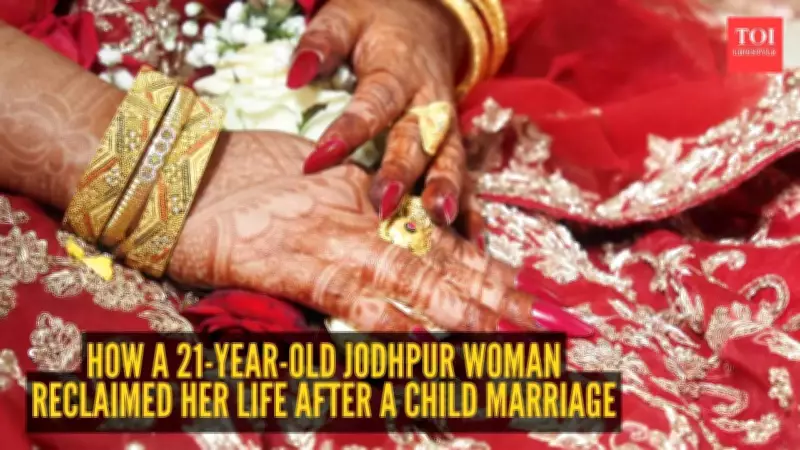
Jodhpur Court Annuls Child Marriage of 21-Year-Old Woman Married at Age 12
"I want to be able to stand on my own two feet," declared 21-year-old Khushbu, her voice radiating a calm yet profound determination. The smile illuminating her face transcends mere relief—it embodies the radiant glow of someone who has triumphantly reclaimed her stolen childhood.
A Childhood Stolen: Marriage at Twelve
Just days ago, a court in Jodhpur formally annulled the marriage that was forcibly imposed on her in 2016, when she was merely 12 years old. Recounting the traumatic event, Khushbu revealed to media that she lacked full comprehension of the proceedings at the time.
"People in the community married me off when I was young," she recalls. "Back then, my parents' opinions didn't really matter. I was still attending school and didn't understand much. I didn't even realize I was getting married—mera shaadi ho rahi thi, mujhe toh kuch samajh hi nahi aa raha tha us time." The memory still leaves her baffled. "It was only when I grew older that I realized I had already been married off."

The Turning Point: Refusal and Legal Battle
This dawning realization gradually solidified into a firm refusal to accept this fate as her destiny. Several years later, escalating pressure from her in-laws—specifically the expectation to undergo the gauna ritual marking the commencement of cohabitation—triggered an internal shift. "I told my family that I didn't want to continue this child marriage," she stated firmly.
Her defiance led her to seek assistance at the local women's police station, the mahila thana, where she first learned about Dr Kriti Bharti. "Didi," as Khushbu affectionately calls her, became the gateway to her liberation. With Bharti's steadfast support, Khushbu's case was presented before the Family Court.
In Jodhpur, Judge Varun Talwar of Family Court Number 2 recently annulled the marriage, unequivocally denouncing child marriage as a crime that devastates both the present and future of children. The court ruled that the marriage violated Section 3 of the Prohibition of Child Marriage Act, 2006, which stipulates that a child marriage is voidable at the option of the individual who was a minor at the time.
A Pillar of Support: Dr Kriti Bharti and Saarthi Trust
This landmark decision culminated approximately 18 arduous, emotionally draining months of Khushbu's relentless fight for annulment, during which she consistently argued that her marriage occurred under intense social pressure without her genuine consent as a 12-year-old.
Khushbu is effusive in her praise for Bharti, the managing trustee of Saarthi Trust and a rehabilitation psychologist, who served as the unwavering pillar throughout her legal struggle. "She filed my case, guided me, stood by me," Khushbu says simply. "Didi ne meri zindagi ki sabse badi khushi di hai—maine apni khudki zindagi ko wapas pa liya. She has given me the biggest happiness of my life."
For Bharti, Khushbu's narrative represents far more than an isolated triumph. "This is not just her victory," she emphasizes, "but a message for society. Every girl possesses the right to say no, the right to declare, 'I'm not ready for this.' Our responsibility extends beyond merely preventing child marriages; it includes rebuilding the lives that were unlawfully stolen."
Rebuilding Life: Education as Empowerment
Khushbu's focus has now decisively shifted toward reconstructing her future, rather than dwelling on past trauma. Forced to abandon her education after Class 7—a direct casualty of her prematurely seized childhood—she is determined to resume her studies. "I want to do something good in life," she asserts. "I don't want to be dependent on anyone." Currently, this resolve translates into preparing for her Class 10 examinations. "I have to fulfill Didi's promise," she reiterates, echoing it like a solemn vow.

Bharti elucidates that education constitutes the fundamental "fee" at Saarthi Trust. "We don't charge them monetarily here," she explains. "They repay us by studying, by growing stronger, by achieving independence. Acquiring an education is paramount above all else." This philosophy transforms empowerment from a distant aspiration into a tangible, daily practice.
Root Causes: Social Customs and Systemic Challenges
Khushbu's ordeal also unveils the deeply entrenched social customs perpetuating child marriage in certain regions of Rajasthan. Bharti describes practices like mausar or nukta pratha—traditions wherein, following the death of a grandparent, all grandchildren are married collectively during a post-death meal ceremony.
"Mausar ke naam par, jab koi dada-dadi ya daadi-nana jaati hain, toh unke sabhi poton-potiyo ki shaadi kara di jaati hai, uske saath mrityubhoj hota hai," Bharti clarifies. "They claim the soul of the deceased will attain peace if all grandchildren are wedded." Under such coercive pressure, there is typically no proper vetting of backgrounds, no authentic consent, and zero tolerance for dissent.
Families resisting compliance often confront threats of social ostracization. "Agar koi parivaar kehne mein nahi aata, toh unhe casta aur samaj se alag karne ka daayan hota hai," Bharti notes. "Consequently, they capitulate, frequently motivated by fear rather than choice."
For over a decade, Bharti has been persistently combating this system, facilitating the annulment of 54 child marriages and preventing more than 2,200 minors from being forcibly married. Each case bears its unique burden, yet every victory—like Khushbu's—sends powerful ripples through the community. "The task remains far from complete," she acknowledges, "but each girl who asserts 'no,' and each courtroom that stands in solidarity with her, incrementally dismantles the myth that this is merely 'tradition.'"
A Beacon for Others: Family Impact and Future Aspirations
Khushbu's journey not only signifies her personal emancipation but also serves as a reflective mirror for her family. Her younger siblings—a brother and a sister—were likewise married as children, with her sister wedded on the identical day. When questioned about them, Khushbu opts for patience over panic.
"Once they mature, they will determine their own desires," she says thoughtfully. "I cannot剥夺 that choice from them. However, I can demonstrate that it is feasible to say no—and that one can not only survive but truly flourish on one's own terms."
Today, when Khushbu articulates her desire to "stand on her own two feet," it transcends metaphorical expression. It represents a solemn promise she is making to herself and to every girl who has yet to discover the courage—or the essential support—to walk away from a childhood usurped by another's rigid interpretation of tradition.





